
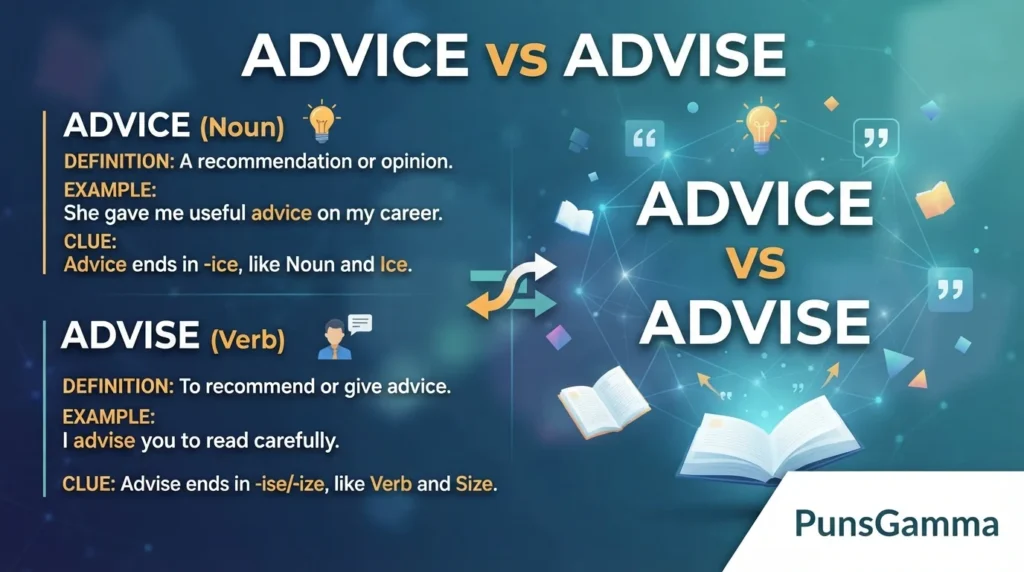
Many English learners confuse advice and advise because they look almost identical and have closely related meanings. However, they serve different grammatical purposes and cannot be used interchangeably. One is a noun, while the other is a verb. Using the wrong one can make your writing sound incorrect, even if your intended meaning is clear.
In this guide, you’ll learn the meaning, pronunciation, grammar, correct usage, common mistakes, and practical examples of both words. By the end, you’ll know exactly when to use advice and when to use advise in everyday conversations and professional writing.
Writers often struggle with Altogether vs All Together Usage Differences when deciding which form fits a sentence.
Quick Difference Table
| Word | Part of Speech | Meaning | Example | Common Usage |
| Advice | Noun | A suggestion or recommendation about what someone should do | She gave me helpful advice. | Giving opinions, recommendations, or guidance |
| Advise | Verb | To give someone guidance or recommendations | I advise you to save money. | Recommending or guiding someone |
Read More: Affect vs Effect
Meaning of Advice

Meaning
Advice is a noun that refers to guidance, suggestions, or recommendations offered to help someone make a decision or solve a problem.
Unlike many nouns, advice is uncountable, which means you do not normally say an advice or advices. Instead, use expressions like some advice, a piece of advice, or a bit of advice.
Examples:
- Can you give me some advice?
- She offered valuable advice before the interview.
- His advice helped me avoid a mistake.
Pronunciation
| Feature | Details |
| IPA | /ədˈvaɪs/ |
| American Pronunciation | uhd-VICE |
| British Pronunciation | uhd-VICE |
| Syllables | 2 (ad-vice) |
| Word Stress | Second syllable (VICE) |
Pronunciation Tips
- The ending sounds like ice.
- The final sound is /s/, not /z/.
- Stress the second syllable.
- Practice saying ad-VICE slowly before increasing your speed.
- Compare it with advise to hear the different ending sounds.
Function
Part of Speech
Advice is a noun.
Grammar Role
It names guidance, recommendations, or opinions given to someone.
Sentence Function
It can function as:
- Subject
- Object
- Object of a preposition
- Complement
Examples:
- Your advice was useful.
- I appreciated your advice.
- We talked about her advice.
- That was excellent advice.
Common Grammatical Patterns
- give advice
- offer advice
- ask for advice
- follow advice
- Brake vs Break
- ignore advice
- seek advice
- take someone’s advice
- valuable advice
- professional advice
- legal advice
Example Sentences
- My teacher gave me useful advice before the exam.
- I always ask my parents for advice when making important decisions.
- Her advice saved me a lot of money.
- Thank you for your honest advice.
- We received professional advice from a financial expert.
- His advice helped me improve my writing skills.
- You should listen carefully to your doctor’s advice.
- She ignored everyone’s advice and made her own decision.
- They asked for advice before buying a new house.
- Good advice can change someone’s life.
When to Use
Use advice whenever you are talking about the guidance or recommendation itself rather than the action of giving it.
Common situations include:
- Asking for recommendations
- Receiving guidance
- Discussing opinions
- Referring to expert suggestions
- Talking about personal or professional recommendations
Examples:
- I need some advice.
- Thank you for your advice.
- His advice was very helpful.
- She asked for career advice.
Common Mistakes
Mistake 1: Using “advices”
❌ He gave me many advices.
✅ He gave me a lot of advice.
Mistake 2: Saying “an advice”
❌ She gave me an advice.
✅ She gave me some advice.
✅ She gave me a piece of advice.
Mistake 3: Using advice as a verb
❌ I advice you to study harder.
✅ I advise you to study harder.
Mistake 4: Confusing pronunciation
Many learners pronounce advice with a z sound at the end.
Correct pronunciation ends with the /s/ sound.
Read More: Angel vs Angle
Meaning of Advise
Meaning
Advise is a verb that means to give guidance, recommendations, or suggestions to someone.
Unlike advice, which names the recommendation, advise describes the action of giving that recommendation.
Examples:
- I advise you to exercise regularly.
- The lawyer advised her to remain calm.
- Doctors advise patients to eat healthy foods.
Pronunciation
| Feature | Details |
| Alter vs Altar | /ədˈvaɪz/ |
| American Pronunciation | uhd-VIZE |
| British Pronunciation | uhd-VIZE |
| Syllables | 2 (ad-vise) |
| Word Stress | Second syllable (VISE) |
Pronunciation Tips
- The ending sounds like zoo without the “oo.”
- The final sound is /z/.
- Stress the second syllable.
- Listen carefully to the difference between advice (/s/) and advise (/z/).
- Repeat both words together to master the contrast.
Function
Part of Speech
Advise is a verb.
Grammar Role
It expresses the action of giving recommendations or guidance.
Sentence Function
It serves as the main verb in a sentence.
Examples:
- I advise everyone to read daily.
- They advised us to leave early.
- The doctor advised him against smoking.
Common Grammatical Patterns
- advise someone
- advise someone to do something
- strongly advise
- highly advise
- advise against
- professionally advise
- advise clients
- advise customers
- advise patients
- advise employees
Example Sentences
- I advise you to save money every month.
- The doctor advised him to rest for a few days.
- Our teacher advised us to read more books.
- She advised her friend to apply early.
- Experts advise people to wear sunscreen daily.
- The lawyer advised his client to remain silent.
- I strongly advise checking your work before submitting it.
- My parents advised me to choose a career I enjoy.
- The manager advised the team to arrive early.
- They advised tourists to avoid the area during the storm.
When to Use
Use advise whenever you mean to give guidance or make a recommendation.
Common situations include:
- Giving recommendations
- Offering professional guidance
- Warning someone
- Suggesting a course of action
- Recommending good habits
Examples:
- I advise you to study every day.
- The coach advised us to practice more.
- Financial experts advise saving for emergencies.
- Doctors advise drinking plenty of water.
Common Mistakes
Mistake 1: Using advise as a noun
❌ Your advise was very helpful.
✅ Your advice was very helpful.
Mistake 2: Confusing spelling
❌ I advice you to be careful.
✅ I advise you to be careful.
Mistake 3: Incorrect pronunciation
Many learners pronounce advise with an s sound.
The correct pronunciation ends with the /z/ sound.
Mistake 4: Omitting the object
While advise can sometimes be used without a direct object, it most commonly follows these patterns:
- advise someone
- advise someone to do something
- advise against something
Examples:
- I advised him to apologize.
- The doctor advised against traveling.
- She advised her students to practice daily.
Read More: Altogether vs All Together
Side-by-Side Comparison
| Situation | Correct Word | Explanation | Example |
| Asking for guidance | Advice | You need the noun because you’re referring to the guidance itself. | Can you give me some advice? |
| Giving a recommendation | Advise | You need the verb because someone is performing the action of recommending. | I advise you to leave early. |
| Talking about a doctor’s recommendation | Advice | Refers to the recommendation received. | I followed my doctor’s advice. |
| A teacher recommends studying | Advise | Describes the action of recommending. | Teachers advise students to practice every day. |
| Receiving career guidance | Advice | Refers to the guidance itself. | She received career advice from her mentor. |
| A lawyer recommends waiting | Advise | Expresses the act of recommending. | The lawyer advised his client to wait. |
| Asking for professional help | Advice | Refers to recommendations from an expert. | We sought financial advice. |
| Warning someone | Advise | Means to recommend or warn someone. | I advise you not to touch the hot pan. |
| Referring to useful suggestions | Advice | The suggestions are a thing, so use the noun. | His advice was extremely helpful. |
| Making a recommendation | Advise | The speaker is performing the action. | Experts advise saving money regularly. |
Practice Quiz
Fill in the Blanks
Choose advice or advise to complete each sentence.
- My grandfather always gives good ________.
- The teacher will ________ us about the project.
- I asked my sister for some ________.
- Doctors ________ patients to exercise regularly.
- Thank you for your helpful ________.
- I strongly ________ checking the weather before traveling.
- She ignored everyone’s ________ and made her own choice.
- Financial experts ________ saving for retirement early.
- We need legal ________ before signing the contract.
- His coach ________ him to practice every day.
Choose the Correct Word
1. Can you give me some ________?
A. advise
B. advice
C. advising
D. advised
2. I ________ you to arrive on time.
A. advice
B. advises
C. advise
D. adviceing
3. Her ________ helped me make the right decision.
A. advise
B. advice
C. advising
D. advised
4. The doctor ________ him to drink more water.
A. advice
B. advise
C. advised
D. advices
5. We received valuable ________ from our accountant.
A. advise
B. advice
C. advising
D. advised
6. I would ________ waiting until tomorrow.
A. advice
B. advise
C. advised
D. adviceing
7. His father’s ________ changed his life.
A. advice
B. advise
C. advising
D. advises
8. Experts ________ people to wear seat belts.
A. advice
B. advises
C. advise
D. adviceing
9. She asked for career ________ before accepting the job.
A. advise
B. advice
C. advised
D. advising
10. I highly ________ reading the instructions first.
A. advice
B. advises
C. advise
D. advices
Answer Key
Fill in the Blanks
- advice – It refers to the guidance being given, so a noun is required.
- advise – The teacher is performing the action of giving guidance.
- advice – You ask for guidance, which is a noun.
- advise – Doctors perform the action of recommending.
- advice – The sentence refers to the recommendation itself.
- advise – The speaker is recommending an action.
- advice – The guidance is the subject of the sentence.
- advise – Experts are giving recommendations.
- advice – Legal guidance is a thing, making it a noun.
- advised – The sentence refers to a past action of recommending.
Multiple-Choice Answers
- B. advice – “Give me” requires a noun.
- C. advise – The sentence needs the base form of the verb.
- B. advice – The guidance itself is being discussed.
- C. advised – The recommendation happened in the past.
- B. advice – Valuable recommendations are nouns.
- B. advise – The speaker is recommending an action.
- A. advice – The sentence refers to guidance received.
- C. advise – Experts perform the action of recommending.
- B. advice – Career guidance is a noun.
- C. advise – The verb expresses the act of recommending.
Final Thoughts
Understanding the difference between advice and advise becomes much easier once you remember their grammatical roles. Advice is always a noun, meaning guidance or a recommendation. Advise is always a verb, meaning to give guidance or recommend something. Although the two words are closely related and sound similar, choosing the correct one depends on whether you’re talking about the recommendation itself or the act of giving it.
A simple memory trick is this: advice ends with “ce,” like “ice,” and names the guidance, while advise ends with “se” and describes the action. Whenever you’re unsure, ask yourself, “Am I naming the recommendation or giving it?” This quick check will help you use both words accurately and confidently in speaking and writing.
Frequently Asked Questions
What is the difference between advice and advise?
Advice is a noun that means guidance or a recommendation, while advise is a verb that means to give guidance or recommend something.
Is advice a noun or a verb?
Advice is always a noun.
Is advise a noun or a verb?
Advise is always a verb.
Why do people confuse advice and advise?
They have similar spellings, related meanings, and nearly identical pronunciations, but they belong to different parts of speech.
How do you pronounce advice?
Advice is pronounced /ədˈvaɪs/ and ends with an /s/ sound.
How do you pronounce advise?
Advise is pronounced /ədˈvaɪz/ and ends with a /z/ sound.
Can I say “an advice”?
No. Advice is an uncountable noun. Say some advice or a piece of advice instead.
Can advice be plural?
Generally, no. Use phrases like pieces of advice instead of advices.
What is a simple way to remember the difference?
Remember that advice is the guidance you receive, while advise is the action of giving that guidance.
Which word follows “give”?
Use advice after give.
Example: She gave me good advice.
Which word follows “I”?
When expressing the action of recommending, use advise.
Example: I advise you to stay calm.
Is “I advice you” correct?
No. The correct sentence is I advise you because a verb is required.
What are common collocations with advice?
Common collocations include give advice, ask for advice, take advice, follow advice, and professional advice.
What are common collocations with advise?
Common collocations include advise someone, advise against, strongly advise, advise clients, and advise patients.

Carter is an English language specialist, author, and senior editor with more than 20 years of experience in English grammar, writing, editing, and language education. Throughout his career, he has worked with educational organizations, digital publishers, and content teams to develop accurate, engaging, and learner-focused resources. His expertise includes English grammar, spelling, vocabulary, commonly confused words, proofreading, copy editing, academic writing, and SEO content strategy. Carter is passionate about helping learners and writers improve their communication skills through clear explanations, practical examples, and high-quality educational content.
1 thought on “Advice or Advise? Correct Pronunciation & Meaning”