
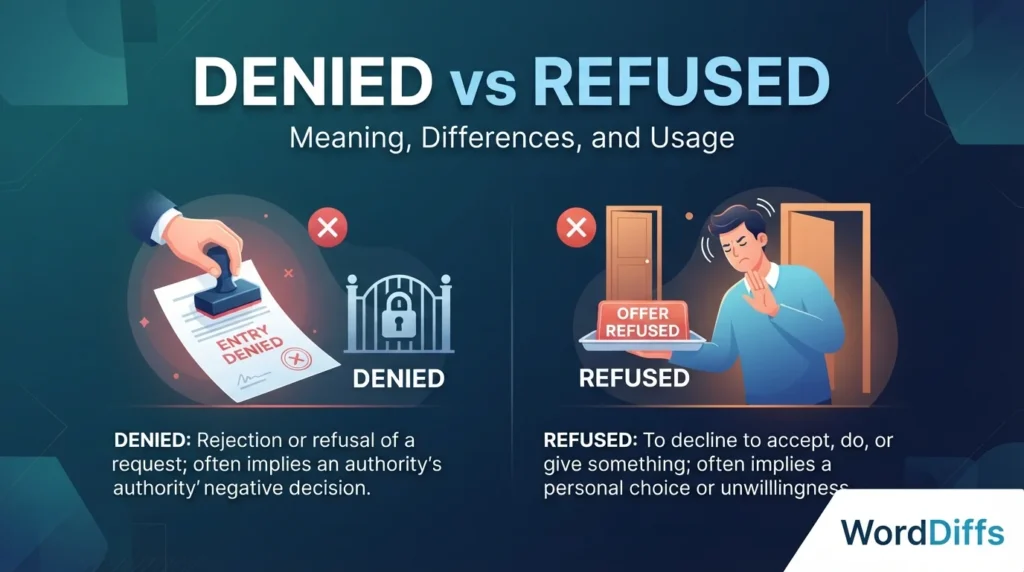
Many English learners confuse denied and refused because both words describe saying “no” in some way. However, they are used in different situations and carry different meanings. Denied usually means that something is declared untrue, rejected, or not allowed. Refused means that someone intentionally chose not to do something or accept something. Understanding this difference can improve both your writing and speaking. In this guide, you’ll learn the meaning, pronunciation, grammar, usage, examples, common mistakes, comparisons, quizzes, and frequently asked questions about Denied vs Refused using simple explanations and real-life examples.
The distinction between Compare vs Contrast usage in English becomes clearer when each word’s purpose is examined.
Quick Difference Table
| Word | Part of Speech | Meaning | Example | Common Usage |
| Denied | Verb (past tense/past participle) | Said something is not true or did not allow something | She denied the accusation. | Claims, access, permission, facts |
| Refused | Verb (past tense of refuse) | Chose not to do, accept, or allow something | He refused the invitation. | Requests, offers, commands, invitations |
Meaning of Denied
Meaning
Denied is the past tense and past participle of deny. It means to declare that something is not true, reject a claim, or prevent someone from having or doing something.
Pronunciation
| Feature | Details |
| IPA | /dɪˈnaɪd/ |
| American Pronunciation | dih-NYD |
| British Pronunciation | dih-NYD |
| Syllables | 2 (de-nied) |
| Word Stress | Second syllable |
Pronunciation Tips
- Stress the second syllable: NYD.
- The ending sounds like “eyed.”
- Keep the first syllable short: dih.
- Practice by saying: “deny” then “denied.”
Function
Part of Speech
Verb (past tense and past participle)
Grammar Role
Shows that someone rejected, contradicted, or did not allow something.
Sentence Function
Usually serves as the main verb.
Common Grammatical Patterns
- denied + noun
- denied + doing something
- denied + that clause
- denied + someone + something
Example Sentences
- She denied breaking the window.
- The company denied the rumor.
- He denied knowing the suspect.
- Our request was denied immediately.
- The bank denied my loan application.
- They denied access to unauthorized visitors.
- Sarah denied that she took the book.
- The witness denied every accusation.
- His insurance claim was denied.
- The athlete denied using illegal drugs.
When to Use
Use denied when:
- Rejecting an accusation.
- Saying something is untrue.
- Rejecting an application.
- Blocking access or permission.
- Rejecting a claim or request officially.
Common Mistakes
- Do not use denied when someone simply chooses not to do something.
- Avoid saying “He denied to help me.” Instead say, “He refused to help me.”
- Remember that deny is commonly followed by a noun, gerund, or that clause.
Meaning of Refused
Meaning
Refused is the past tense and past participle of refuse. It means someone deliberately chose not to accept, do, or allow something.
Pronunciation
| Feature | Details |
| IPA | /rɪˈfjuːzd/ |
| American Pronunciation | rih-FYOOZD |
| British Pronunciation | rih-FYOOZD |
| Syllables | 2 (re-fused) |
| Word Stress | Second syllable |
Pronunciation Tips
- Stress the second syllable.
- The ending sounds like “fyoozd.”
- Do not confuse it with refuse meaning trash, which has different stress.
- Practice slowly before increasing speed.
Function
Part of Speech
Verb (past tense and past participle)
Grammar Role
Shows that someone intentionally rejected an offer, request, invitation, or command.
Sentence Function
Usually functions as the main verb.
Common Grammatical Patterns
- refused + noun
- refused + to + verb
- refused + request
- refused + offer
Understanding Cloth vs Clothe meaning and differences helps distinguish these commonly confused English words.
Example Sentences
- She refused to answer the question.
- He refused my invitation.
- The child refused to eat vegetables.
- They refused to sign the contract.
- I refused the job offer.
- The customer refused a refund.
- We refused to give up.
- She refused to apologize.
- He refused their request politely.
- The driver refused to stop.
When to Use
Use refused when:
- Turning down an offer.
- Rejecting a request.
- Choosing not to obey.
- Declining an invitation.
- Deciding not to accept something.
Common Mistakes
- Do not use refused when talking about proving something untrue.
- Avoid saying “She refused the accusation.” Instead say, “She denied the accusation.”
- Remember that refuse is commonly followed by to + verb.
Side-by-Side Comparison
| Situation | Correct Word | Explanation | Example |
| Rejecting an accusation | Denied | Said it was not true | He denied stealing the money. |
| Turning down an invitation | Refused | Chose not to accept | She refused the invitation. |
| Rejecting a loan | Denied | Official rejection | The bank denied the loan. |
| Not following an order | Refused | Deliberate choice | He refused to obey. |
| Rejecting access | Denied | Permission not given | Visitors were denied entry. |
| Rejecting an offer | Refused | Declined willingly | I refused the offer. |
| Saying a rumor is false | Denied | Declared untrue | The actor denied the rumor. |
| Choosing not to help | Refused | Personal decision | She refused to help. |
| Rejecting insurance | Denied | Official decision | The claim was denied. |
| Declining food | Refused | Chose not to eat | The child refused dinner. |
Practice Quiz
Fill in the Blanks
- The bank ________ my mortgage application.
- She ________ to attend the meeting.
- He ________ all the accusations.
- The waiter ________ to serve alcohol to minors.
- Our request was ________ because it was incomplete.
- They ________ to leave the building.
- The athlete ________ using banned substances.
- She ________ the expensive gift.
- Access was ________ due to security concerns.
- He ________ to answer the reporter’s question.
Choose the Correct Word
1. She ________ the invitation.
A. Denied
B. Refused
C. Denying
D. Denial
2. The company ________ the allegations.
A. Refused
B. Refused to
C. Denied
D. Refusal
3. He ________ to apologize.
A. Denied
B. Refused
C. Denial
D. Denying
4. My visa was ________.
A. Refused to
B. Denied
C. Deny
D. Refusing
5. She ________ knowing him.
A. Refused
B. Denied
C. Refusal
D. Refuses
6. They ________ our request politely.
A. Refused
B. Denied to
C. Denial
D. Denying
7. The suspect ________ every charge.
A. Refused
B. Denied
C. Refusing
D. Refusal
8. He ________ to cooperate.
A. Denied
B. Refused
C. Denial
D. Denies
9. Entry was ________.
A. Refused to
B. Denied
C. Refuse
D. Refusal
10. She ________ the offer because she already had a job.
A. Denied
B. Refused
C. Denying
D. Denial
Answer Key
- Denied. Banks officially deny applications.
- Refused. Invitations are declined voluntarily.
- Denied. Accusations are declared untrue.
- Refused. Someone chooses not to serve.
- Denied. Official requests can be denied.
- Refused. People choose not to leave.
- Denied. Someone rejects the truth of an accusation.
- Refused. Gifts are accepted or refused.
- Denied. Access or entry is officially denied.
- Refused. Someone chooses not to answer.
Multiple Choice
- B. “Refused the invitation” is the correct expression.
- C. Allegations are denied.
- B. We say “refused to apologize.”
- B. Visas are commonly denied.
- B. We say “denied knowing.”
- A. Requests can be refused politely.
- B. Charges are denied.
- B. “Refused to cooperate” is correct.
- B. Entry is denied.
- B. Offers are refused.
Final Thoughts
Although denied and refused both involve rejection, they are not interchangeable. Denied is mainly used when rejecting a statement, claim, accusation, application, permission, or access. Refused is used when someone makes a conscious decision not to accept, do, or allow something. A simple memory trick is this: deny a fact, refuse an action. If someone says something is not true, use denied. If someone chooses not to do something, use refused. Learning this distinction will help you write more naturally, avoid common grammar mistakes, and communicate more confidently in everyday English.
Frequently Asked Questions
What is the main difference between denied and refused?
Denied rejects a claim or permission, while refused describes choosing not to do or accept something.
Can denied and refused be used interchangeably?
No. They overlap in meaning but are used in different grammatical and contextual situations.
Is denied always about something being untrue?
Not always. It can also mean refusing permission or access.
Is refused always a personal choice?
Usually, yes. It shows that someone deliberately declined or rejected something.
Can I say “denied to help”?
No. The correct expression is refused to help.
Can I say “refused the accusation”?
Normally, no. The natural expression is denied the accusation or denied the allegations.
Which word is used with applications?
Denied is commonly used with loan, visa, insurance, and admission applications.
Which word is followed by “to + verb”?
Refused is commonly followed by to + verb.
Which word is more common in legal situations?
Denied is more common when discussing accusations, evidence, or legal claims.
Are both words verbs?
Yes. Both are verbs in the past tense and past participle forms.
What is an easy way to remember the difference?
Remember: deny a fact, refuse an action.
Which word is used for invitations?
Refused is the correct choice because an invitation is something you choose to accept or decline.

Lauren Kafka is an experienced freelance writer, editor, English tutor, and writing coach with extensive expertise in education, journalism, publishing, and communications. She is the founder of Kafka Consulting LLC, where she provides private English tutoring, writing coaching, and educational consulting services for K-12 students, college students, graduate students, and adults.