
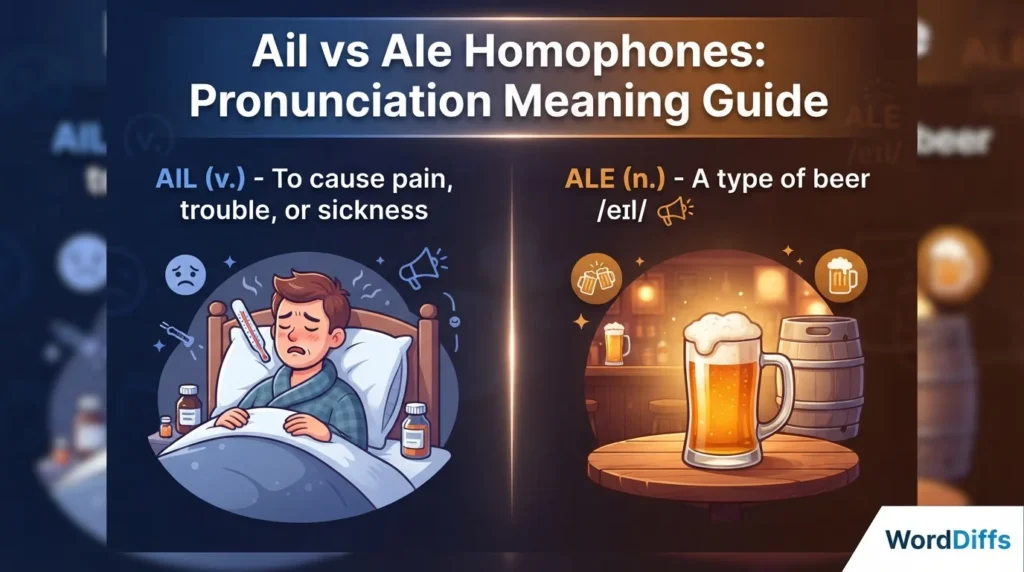
English homophones often confuse learners because two or more words can sound exactly alike while having completely different meanings and spellings. Ail and Ale are a good example. Although they share the same pronunciation in most English accents, they belong to different parts of speech and are used in completely different situations. Choosing the wrong spelling can change the meaning of your sentence and create confusion in both speaking and writing.
Correct spelling and word choice are important in school assignments, professional writing, everyday conversations, and English proficiency exams. Understanding pronunciation also helps learners recognize these words when listening to native speakers.
This guide explains the differences between Ail and Ale in a simple, beginner-friendly way. You will learn their pronunciation, meanings, grammar, origins, common uses, collocations, and plenty of original examples. By the end, you will be able to use each word confidently and avoid one of the most common homophone mistakes.
Quick Difference Table
| Word | Part of Speech | Meaning | Pronunciation (IPA) | Usage | Example |
| Ail | Verb | To trouble, affect, or cause illness or problems | /eɪl/ | Health, physical or emotional problems | What seems to ail you today? |
| Ale | Noun | A type of beer made with top-fermenting yeast | /eɪl/ | Food, drinks, pubs, brewing | He ordered a glass of ale. |
Ail
Pronunciation
The word ail is pronounced:
IPA: /eɪl/
Simple pronunciation: AYL
Audio-style spelling: ayl
The word sounds exactly the same as ale in standard English pronunciation.
British English: /eɪl/
American English: /eɪl/
There is no meaningful pronunciation difference between British and American English for this word.
Meaning
Ail means to cause pain, discomfort, illness, or trouble. It usually refers to physical illness, emotional distress, or something that negatively affects a person, group, or system.
In everyday English, the verb often appears in questions such as, “What ails you?” It can also describe problems affecting businesses, economies, or societies.
Part of Speech
Ail is a verb.
It functions as an action word that describes suffering from an illness or being troubled by something.
Examples:
- The flu continues to ail many residents.
- What ails the computer?
- Stress can ail both body and mind.
Origin
The word ail comes from Old English “eglian,” meaning “to trouble,” “to afflict,” or “to cause pain.” Its roots go back to Germanic languages, where similar words described causing discomfort or suffering.
Although the word has existed for centuries, modern English uses it less frequently than verbs like hurt, affect, or trouble. However, it still appears regularly in literature, journalism, and formal writing.
Common Uses
People commonly use ail in the following situations:
- Discussing illnesses
- Describing medical conditions
- Talking about emotional distress
- Referring to economic or social problems
- Literary writing
- News reports
- Formal discussions
- Medical conversations
- Educational writing
- Historical texts
Common Collocations
Some common collocations include:
- ail someone
- ail the patient
- ail the economy
- ail the nation
- ail your health
- ail the body
- ail the mind
- ail society
- ail the system
- ail an organization
- ail a community
- ail children
- ail older adults
- seriously ail
- chronically ail
Example Sentences
- What seems to ail you today?
- A high fever began to ail the child overnight.
- Stress can ail both the body and the mind.
- Doctors worked quickly to discover what might ail the patient.
- Financial problems continue to ail the company.
- Poor nutrition may ail growing children.
- Nobody knew what continued to ail the old dog.
- The disease can ail people of every age.
- Lack of sleep may ail your concentration.
- Pollution continues to ail many large cities.
- The mysterious illness began to ail several workers.
- Anxiety can ail even healthy individuals.
- Researchers hope to understand what ails the environment.
- The athlete refused to admit what was beginning to ail him.
- Hidden problems continued to ail the organization for years.
Ale
Pronunciation
The word ale is pronounced:
IPA: /eɪl/
Simple pronunciation: AYL
Audio-style spelling: ayl
It is pronounced exactly the same as ail.
British English: /eɪl/
American English: /eɪl/
Native speakers generally pronounce both words identically.
Meaning
Ale is a type of beer produced through top fermentation. It is one of the oldest alcoholic beverages and is often associated with traditional breweries and pubs.
Today, the word is common in discussions about brewing, restaurants, history, and food culture.
Part of Speech
Ale is a noun.
It names a thing, specifically a kind of alcoholic drink.
Examples:
- The brewery produces excellent ale.
- They served local ale at dinner.
- Fresh ale was available at the festival.
Origin
The word ale comes from Old English “ealu,” which referred to fermented grain drinks. Similar words existed throughout ancient Germanic languages long before modern English developed.
Ale has been brewed for thousands of years and remains an important part of British and European brewing traditions.
Common Uses
People commonly use ale when discussing:
- Beer
- Breweries
- Traditional pubs
- Food pairings
- Festivals
- Medieval history
- Craft brewing
- Restaurant menus
- Beverage reviews
- Brewing techniques
Common Collocations
Common collocations include:
- pale ale
- brown ale
- amber ale
- golden ale
- craft ale
- local ale
- traditional ale
- fresh ale
- strong ale
- seasonal ale
- bottled ale
- homemade ale
- English ale
- drink ale
- serve ale
Example Sentences
- He ordered a cold ale after work.
- The brewery produces award-winning ale.
- They sampled several kinds of ale.
- Traditional ale remains popular in many pubs.
- She preferred ale over other beers.
- The waiter recommended a local ale.
- Fresh ale was served during the festival.
- The old tavern became famous for its dark ale.
- Visitors enjoyed tasting handmade ale.
- The menu listed several craft ales.
- The brewer carefully prepared each batch of ale.
- A pale ale paired well with the meal.
- Historians studied how medieval ale was made.
- The village celebrates its annual ale festival.
- He learned the traditional methods of brewing ale.
Pronunciation Comparison
Ail and Ale are considered perfect homophones in standard English because they share the same pronunciation: /eɪl/.
Both British English and American English pronounce them almost identically. Regional accents may slightly affect vowel quality, but the two words still sound the same within each accent.
This identical pronunciation is why learners frequently confuse their spellings. Since listeners cannot distinguish the words by sound alone, the surrounding context becomes essential. If someone says, “What ails you?” the discussion is about illness or trouble. If someone says, “I’d like an ale,” the conversation is about a beverage.
Remember that pronunciation alone cannot tell you which spelling is correct. Always consider the meaning of the sentence.
Grammar Differences
| Word | Part of Speech | Meaning | Function | Sentence Position | Verb Forms (If Applicable) | Plural Forms (If Applicable) |
| Ail | Verb | To trouble, affect, or cause illness | Main verb | After the subject or with auxiliaries | ail, ails, ailed, ailing | Not applicable |
| Ale | Noun | A fermented alcoholic drink | Subject, object, or complement | Anywhere a noun is required | Not applicable | ale, ales |
Side-by-Side Examples
The following table compares ail and ale in similar contexts so you can clearly see the difference in meaning and usage.
| Ail | Ale |
| What seems to ail you today? | He ordered a glass of ale with dinner. |
| Stress can ail your health over time. | The pub serves traditional English ale. |
| The doctors tried to discover what continued to ail the patient. | She enjoyed a refreshing ale after hiking. |
| Financial problems still ail the company. | The brewery produces several kinds of craft ale. |
| Lack of sleep may ail your memory. | They sampled local ale during the festival. |
| Pollution continues to ail many cities. | A dark ale paired well with the roasted meat. |
| Nobody could explain what began to ail the horse. | The bartender recommended a pale ale. |
| The mysterious illness continued to ail several villagers. | Fresh ale was available throughout the celebration. |
| Anxiety can ail both children and adults. | Visitors bought bottles of homemade ale. |
| Researchers hope to learn what may ail the ecosystem. | The tavern became famous for its amber ale. |
| Poor nutrition can ail growing children. | He prefers ale to other types of beer. |
| Hidden issues continue to ail the organization. | The brewery introduced a seasonal ale. |
| The cold weather seemed to ail her joints. | They brewed ale using traditional methods. |
| What exactly does ail your computer? | The menu included several imported ales. |
| A chronic illness continued to ail the elderly man. | The guests toasted with cold ale. |
| Uncertainty can ail the economy. | A golden ale complemented the seafood dish. |
| Fatigue began to ail the marathon runner. | They visited a museum dedicated to historic ale production. |
| The veterinarian identified what continued to ail the cat. | Every autumn the village hosts an ale festival. |
| Emotional stress may ail your well-being. | The brewer carefully aged the ale before serving it. |
| Experts studied the factors that ail the environment. | She ordered another ale after finishing her meal. |
Homophones Comparison Table
| Word | Pronunciation | Meaning | Part of Speech | Usage | Example |
| Ail | /eɪl/ (AYL) | To trouble, affect, or make someone ill | Verb | Health, emotions, organizations, society | What seems to ail you today? |
| Ale | /eɪl/ (AYL) | A type of beer brewed with top-fermenting yeast | Noun | Brewing, pubs, restaurants, history | He ordered a pint of ale. |
Memory Tricks
Remembering the difference between ail and ale becomes much easier with a few simple techniques.
Think About the Meaning
- Ail relates to aches, illnesses, and problems.
- Ale refers to an alcoholic drink.
Letter Association
- Ail contains “il”, which reminds many learners of ill.
- Ale ends in “le”, similar to words related to beverages like bottle.
Visual Memory Trick
Imagine two pictures:
- A sick person asking, “What ails me?”
- A person raising a mug of ale in a pub.
The mental images help connect each spelling with its meaning.
Sentence Practice
Create your own sentences using both words.
Example:
- The flu continued to ail him.
- He enjoyed a cold ale with dinner.
Context Clues
If the sentence discusses:
- Health, pain, or problems → ail
- Beer, brewing, pubs, or drinks → ale
Common Mistakes
| Incorrect Sentence | Correct Sentence | Explanation |
| He drank an ail after work. | He drank an ale after work. | Ale is the beverage. |
| What ale you today? | What ails you today? | Ails is the correct verb form. |
| The brewery sells excellent ails. | The brewery sells excellent ales. | Plural noun is ales. |
| Stress can ale your health. | Stress can ail your health. | Ail means to trouble or affect. |
| She ordered a glass of ail. | She ordered a glass of ale. | Use ale for the drink. |
| The illness continued to ale him. | The illness continued to ail him. | The verb is ail. |
| Fresh ail was served at the pub. | Fresh ale was served at the pub. | Beverage spelling is ale. |
| Doctors treated what ale the patient. | Doctors treated what ailed the patient. | Past tense is ailed. |
| The company was ale by debt. | The company was ailed by debt. | Use the verb ailed. |
| We tasted local ail during vacation. | We tasted local ale during vacation. | Correct noun spelling is ale. |
| Pollution continues to ale the city. | Pollution continues to ail the city. | Ail describes causing problems. |
| They brew traditional ails. | They brew traditional ales. | Use the plural noun ales. |
| Anxiety may ale your sleep. | Anxiety may ail your sleep. | Ail is the correct verb. |
| He enjoys drinking dark ail. | He enjoys drinking dark ale. | Ale is the type of beer. |
| Nobody knew what ale her. | Nobody knew what ailed her. | Past tense verb is ailed. |
Fill in the Blank Quiz
Choose ail or ale to complete each sentence.
- What seems to ______ you today?
- He ordered a glass of ______.
- Stress can ______ your health.
- The brewery produces excellent ______.
- Nobody knew what continued to ______ the child.
- She prefers dark ______.
- Lack of exercise may ______ your body.
- We sampled local ______ at the festival.
- Doctors discovered what began to ______ him.
- The village is famous for its craft ______.
- Financial troubles continue to ______ the business.
- They served fresh ______ with dinner.
- Poor sleep can ______ your concentration.
- The pub offers several imported ______.
- Anxiety may ______ your confidence.
- The brewer prepared a seasonal ______.
- The illness continued to ______ her.
- Visitors bought bottles of ______.
- What exactly does ______ your dog?
- He enjoyed a traditional English ______.
Answer Key
- ail
- ale
- ail
- ale
- ail
- ale
- ail
- ale
- ail
- ale
- ail
- ale
- ail
- ales
- ail
- ale
- ail
- ale
- ail
- ale
Choose the Correct Word Quiz
1. What seems to _____ you today?
A. Ale
B. Ail
C. Ales
D. Ailing
Correct Answer: B. Ail
Explanation: Ail means to trouble or affect someone.
2. He ordered a pint of _____ at the pub.
A. Ail
B. Ails
C. Ale
D. Ailing
Correct Answer: C. Ale
Explanation: Ale is a type of beer.
3. Stress can _____ your physical health.
A. Ale
B. Ail
C. Ales
D. Aled
Correct Answer: B. Ail
Explanation: The sentence requires a verb meaning “to affect negatively.”
4. The brewery specializes in craft _____.
A. Ale
B. Ail
C. Ails
D. Ailing
Correct Answer: A. Ale
Explanation: A brewery produces ale, not ail.
5. Nobody knew what continued to _____ the patient.
A. Ale
B. Ales
C. Ail
D. Aled
Correct Answer: C. Ail
Explanation: Ail is the correct verb.
6. We tasted local _____ during our trip.
A. Ail
B. Ale
C. Ailing
D. Ails
Correct Answer: B. Ale
Explanation: The sentence refers to a drink.
7. Financial difficulties continue to _____ the company.
A. Ail
B. Ale
C. Ales
D. Aled
Correct Answer: A. Ail
Explanation: Ail means to trouble or harm.
8. The menu listed several imported _____.
A. Ails
B. Ail
C. Ales
D. Ailing
Correct Answer: C. Ales
Explanation: The plural of ale is ales.
9. What exactly _____ your computer?
A. Ale
B. Ails
C. Ales
D. Aled
Correct Answer: B. Ails
Explanation: Third-person singular verb form is ails.
10. The tavern became famous for its dark _____.
A. Ail
B. Ails
C. Aled
D. Ale
Correct Answer: D. Ale
Explanation: The sentence refers to a type of beer.
11. Lack of sleep may _____ your concentration.
A. Ale
B. Ales
C. Ail
D. Aled
Correct Answer: C. Ail
Explanation: Ail means to negatively affect.
12. The brewer created a seasonal _____.
A. Ale
B. Ail
C. Ails
D. Ailing
Correct Answer: A. Ale
Explanation: Brewers make ale.
13. Anxiety can _____ even healthy people.
A. Ale
B. Ales
C. Aled
D. Ail
Correct Answer: D. Ail
Explanation: The verb ail means to trouble or affect.
14. Visitors enjoyed several varieties of _____.
A. Ailing
B. Ails
C. Ales
D. Ail
Correct Answer: C. Ales
Explanation: Multiple types of ale are called ales.
15. Doctors tried to identify what _____ the child.
A. Aled
B. Ailed
C. Ale
D. Ales
Correct Answer: B. Ailed
Explanation: Ailed is the past tense of ail.
Common Expressions
Ail
What Ails You?
Meaning: What problem or illness is affecting you?
Example: The doctor asked, “What ails you today?”
What Ails Society?
Meaning: What problems are affecting a community or nation.
Example: Experts debated what ails modern society.
Ailing Health
Meaning: Poor or declining health.
Example: His ailing health prevented him from traveling.
Ailing Economy
Meaning: An economy experiencing difficulties.
Example: New policies were introduced to support the ailing economy.
Ailing Industry
Meaning: A business sector facing problems.
Example: Investors looked for ways to revive the ailing industry.
Ale
Pale Ale
Meaning: A light-colored style of ale.
Example: The brewery’s pale ale became very popular.
Amber Ale
Meaning: An amber-colored ale.
Example: She preferred amber ale because of its balanced flavor.
Brown Ale
Meaning: A dark brown variety of ale.
Example: The pub serves an excellent brown ale.
Craft Ale
Meaning: Ale produced by small independent breweries.
Example: Craft ale festivals attract thousands of visitors each year.
Traditional Ale
Meaning: Ale brewed using classic methods.
Example: The village is famous for its traditional ale.
Frequently Asked Questions
What Is the Difference Between Ail and Ale?
The difference is simple. Ail is a verb meaning to trouble, affect, or cause illness. Ale is a noun referring to a type of beer. Although they sound identical, their meanings and grammatical functions are completely different.
Are Ail and Ale Pronounced the Same?
Yes. In standard British and American English, both words are pronounced /eɪl/. Because they sound the same, they are considered perfect homophones. Context and spelling are the only ways to tell them apart in writing.
Why Do People Confuse These Homophones?
People confuse them because they share the same pronunciation. When listening, there is no difference in sound. Learners must rely on sentence meaning and context to determine which spelling is correct.
Is Ail a Verb or a Noun?
Ail is primarily a verb. It means to trouble, affect, or make someone ill. It is commonly used in expressions such as What ails you? and Financial issues ail the company.
Is Ale a Verb?
No. Ale is a noun. It refers to a fermented alcoholic drink similar to beer. It does not function as a verb in standard English usage.
Can Ail Refer to Emotional Problems?
Yes. While often used for physical illness, ail can also describe emotional, social, financial, or organizational problems. For example, Stress continues to ail many workers.
Is Ale Still Commonly Used Today?
Yes. The word ale remains common in discussions about brewing, pubs, restaurants, and craft beverages. Many breweries produce different varieties of ale around the world.
How Can I Remember the Difference Between Ail and Ale?
Associate ail with illness because both words relate to health problems. Associate ale with alcohol, since ale is a beverage. These simple associations help many learners remember the correct spelling.
What Is the Past Tense of Ail?
The past tense is ailed.
Examples:
- The illness ailed him for months.
- Financial troubles ailed the business last year.
Can Ale Be Countable?
Yes. When referring to different types or servings, ale can be countable.
Examples:
- The brewery offers several ales.
- We sampled three different ales.
Which Word Appears More Often in Everyday Conversation?
Ale is generally more common in everyday speech, especially in regions with strong brewing traditions. Ail appears more frequently in formal writing, healthcare discussions, journalism, and literature.
Are There Regional Pronunciation Differences?
Some accents may slightly change vowel quality, but ail and ale remain homophones in virtually all major English dialects. Speakers generally pronounce them the same way.
Tips to Remember the Difference
- Read books, articles, and conversations containing both words.
- Create flashcards with meanings and examples.
- Practice writing five sentences with ail and five with ale.
- Listen to native speakers using the words in context.
- Focus on sentence meaning rather than pronunciation.
- Learn common collocations such as ailing health and pale ale.
- Use vocabulary journals to record examples.
- Practice weekly quizzes to reinforce learning.
- Read your sentences aloud while checking spelling.
- Create visual associations between illness and ail, and beer and ale.
- Build vocabulary through extensive reading.
- Review mistakes regularly and correct them immediately.
Summary
Understanding Ail vs Ale is important because these words are perfect homophones that sound exactly alike but have very different meanings. Ail is a verb that means to trouble, affect, or cause illness. It is commonly used when discussing health issues, emotional difficulties, social problems, or challenges affecting organizations and communities. Ale, on the other hand, is a noun referring to a type of beer produced through traditional brewing methods.
Both words are pronounced /eɪl/ in British and American English, which is why many learners confuse them. The key to choosing the correct spelling is understanding the context. If the sentence relates to sickness, trouble, or problems, use ail. If it refers to a beverage, brewing, pubs, or beer, use ale.
Helpful memory tricks include connecting ail with illness and ale with alcohol. Regular reading, writing practice, pronunciation exercises, and sentence creation can strengthen your understanding. Once you focus on meaning rather than sound, distinguishing between ail and ale becomes much easier and more natural.

Carter is an English language specialist, author, and senior editor with more than 20 years of experience in English grammar, writing, editing, and language education. Throughout his career, he has worked with educational organizations, digital publishers, and content teams to develop accurate, engaging, and learner-focused resources. His expertise includes English grammar, spelling, vocabulary, commonly confused words, proofreading, copy editing, academic writing, and SEO content strategy. Carter is passionate about helping learners and writers improve their communication skills through clear explanations, practical examples, and high-quality educational content.