
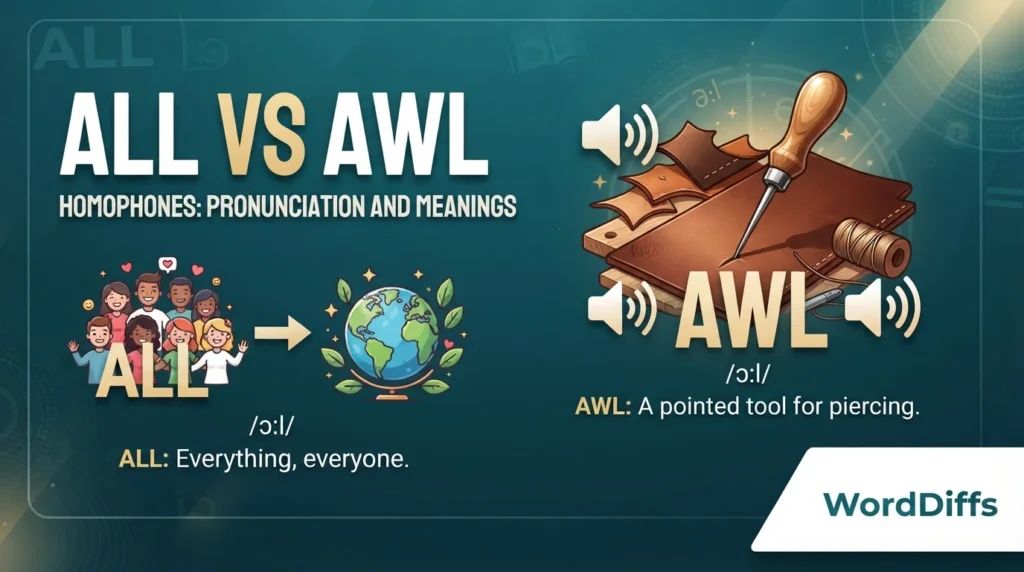
English homophones can be challenging because two or more words may sound exactly alike while having completely different meanings, spellings, and grammatical roles. All and awl are perfect examples. Although they are pronounced the same in most varieties of English, they belong to different parts of speech and are used in completely different situations. Using the wrong spelling can confuse readers and change the meaning of a sentence.
Learning the difference between all and awl improves your spelling, vocabulary, pronunciation, and overall communication skills. It also helps you write more accurately in school, at work, and in everyday conversations. In this guide, you will learn the pronunciation, meanings, grammar, origins, common uses, collocations, and example sentences for each word. You will also discover pronunciation comparisons, grammar differences, memory tips, quizzes, frequently asked questions, and practical strategies that make these homophones easy to remember and use correctly.
Quick Difference Table
| Word | Part of Speech | Meaning | Pronunciation (IPA) | Usage | Example |
| All | Determiner, pronoun, adverb | The whole amount, every person or thing | /ɔːl/ (UK), /ɔl/ or /ɑl/ (US) | Refers to an entire group or quantity | All students passed the exam. |
| Awl | Noun | A pointed hand tool used for making holes | /ɔːl/ (UK), /ɔl/ or /ɑl/ (US) | Used in leatherworking, woodworking, and crafts | The shoemaker sharpened the awl. |
All
Pronunciation
IPA
- British English: /ɔːl/
- American English: /ɔl/ or /ɑl/
Simple pronunciation
“All” sounds like awl, wall (without the first sound), or call (without the first sound).
Audio-style spelling
AWL
Homophone status
“All” is pronounced exactly the same as awl in standard British and American English.
British pronunciation
The vowel is usually longer, sounding like /ɔːl/.
American pronunciation
Many speakers pronounce it as /ɔl/, while others use /ɑl/ depending on regional accent.
Meaning
All refers to the complete amount or every member of a group. It expresses the idea of nothing being left out.
In everyday English, it often means “everything,” “everyone,” or “the whole quantity.”
It is one of the most common words in English and appears in both spoken and written language.
Part of Speech
Determiner
It modifies a noun.
- All children need encouragement.
Pronoun
It replaces a noun phrase.
- All were welcomed.
Adverb
It emphasizes degree or completeness.
- She was all alone.
Origin
The word all comes from the Old English eall, meaning “entire,” “whole,” or “every.” It has Germanic roots and has been used in English for over one thousand years. Despite changes in pronunciation over the centuries, its meaning has remained remarkably consistent.
Common Uses
Everyday English
- All my friends arrived.
- All the lights are off.
- All day long.
Formal English
- All participants must register.
- All evidence was reviewed.
Informal English
- That’s all.
- All good!
- All set?
Academic English
- All variables were measured carefully.
- All samples were tested twice.
Common Collocations
- all day
- all night
- all year
- all week
- all morning
- all evening
- all together
- all alone
- all around
- all over
- all the time
- all of a sudden
- all students
- all members
- all rights
Example Sentences
- All of the books are on the shelf.
- We spent all afternoon at the beach.
- All students should complete the assignment.
- She thanked all her supporters.
- All the windows were open.
- They finished all the work before noon.
- I invited all my cousins to dinner.
- All roads were closed because of the parade.
- He drank all the water in the bottle.
- All children deserve a quality education.
- The audience remained silent throughout all the speeches.
- We searched all over the house for the keys.
- All of us enjoyed the concert.
- She smiled at all the guests.
- After all the preparation, the event was a success.
Awl
Pronunciation
IPA
- British English: /ɔːl/
- American English: /ɔl/ or /ɑl/
Simple pronunciation
“Awl” is pronounced exactly like all.
Audio-style spelling
AWL
Homophone status
It is a perfect homophone of all.
British pronunciation
Usually pronounced /ɔːl/.
American pronunciation
Typically /ɔl/ or /ɑl/ depending on regional accent.
Meaning
An awl is a small, pointed hand tool used to pierce or mark holes in materials such as leather, wood, canvas, or thick fabric.
It is commonly used by shoemakers, leatherworkers, tailors, bookbinders, and woodworkers.
Part of Speech
Noun
It names a physical tool.
Example:
- The carpenter reached for an awl.
Origin
The word awl comes from Old English æl, referring to a pointed instrument used for piercing materials. It has been part of English vocabulary for many centuries and continues to be used in craft, woodworking, and leatherworking.
Common Uses
Everyday English
Although less common than all, the word appears when discussing tools and crafts.
Professional Usage
- Leatherworking
- Shoemaking
- Woodworking
- Bookbinding
Technical Usage
Instructions for hand tools often mention an awl for marking or piercing holes before inserting nails, screws, or stitching.
Common Collocations
- stitching awl
- sewing awl
- leather awl
- woodworking awl
- sharp awl
- pointed awl
- use an awl
- handle an awl
- awl handle
- awl blade
- marking awl
- scratch awl
- diamond awl
- saddle awl
- awl tip
Example Sentences
- The leatherworker used an awl to make neat holes.
- An awl is useful when stitching thick leather.
- The carpenter sharpened the awl before starting work.
- She bought a new awl for her craft kit.
- The shoemaker reached for his favorite awl.
- Use an awl to mark the drilling point.
- The awl pierced the leather with ease.
- He stored the awl safely after finishing the project.
- Every beginner should learn how to handle an awl properly.
- The stitching awl made the repair much easier.
- The craft instructor demonstrated the correct way to hold an awl.
- An awl can create precise guide holes in wood.
- The old awl still worked perfectly after many years.
- She carried an awl in her leatherworking toolbox.
- A sharp awl improves both speed and accuracy.
Pronunciation Comparison
Are these words perfect homophones?
Yes. All and awl are considered perfect homophones because they share the same pronunciation while having different spellings and meanings.
Do they sound identical?
In standard British and American English, they sound identical. Listeners rely entirely on context to understand which word is intended.
British English
Both words are generally pronounced /ɔːl/.
American English
Most speakers pronounce both as /ɔl/ or /ɑl/. The pronunciation remains the same for both words.
Regional Variations
Some regional accents may slightly change the vowel quality, but both words continue to sound alike within the same accent.
Why learners confuse these words
Learners often hear the sound “awl” and are unsure whether the speaker means the common word all or the tool awl. Since all is extremely frequent and awl is relatively uncommon, many learners incorrectly write all even when discussing tools.
Grammar Differences
| Word | Part of Speech | Meaning | Function | Sentence Position | Verb Forms (If Applicable) | Plural Forms (If Applicable) |
| All | Determiner, Pronoun, Adverb | Entire amount or every member | Modifies nouns, replaces noun phrases, or emphasizes completeness | Before nouns, as a subject, object, or complement | Not applicable | Not applicable |
| Awl | Noun | A pointed tool for making holes | Names a tool | Subject, object, or complement | Not applicable | Awls |
Side-by-Side Examples
| Sentence Using All | Sentence Using Awl |
| All the cookies disappeared quickly. | The awl made a clean hole in the leather. |
| All guests arrived before dinner. | He kept the awl in a wooden toolbox. |
| All of us agreed with the decision. | She used an awl to prepare the stitching holes. |
| All the lights were switched off. | The old awl had a polished wooden handle. |
| All birds need water. | A sharp awl improves precision. |
| All employees attended the meeting. | The instructor demonstrated how to use an awl safely. |
| All roads lead to the town center. | He replaced his damaged awl with a new one. |
| All children enjoyed the game. | The awl pierced the canvas easily. |
| All the flowers bloomed early. | She bought a professional stitching awl. |
| All my questions were answered. | Keep the awl away from young children. |
Homophones Comparison Table
| Word | Pronunciation | Meaning | Part of Speech | Usage | Example |
| All | /ɔːl/ (UK), /ɔl/, /ɑl/ (US) | The whole amount or every person or thing | Determiner, pronoun, adverb | Refers to an entire group, quantity, or degree | All the guests enjoyed the celebration. |
| Awl | /ɔːl/ (UK), /ɔl/, /ɑl/ (US) | A pointed hand tool for making holes | Noun | Used in leatherworking, woodworking, and crafts | The craftsman sharpened the awl before using it. |
Memory Tricks
- All has three letters and refers to the whole group or everything.
- Think of the phrase “all together.” It always relates to everyone or everything.
- Awl begins with “aw,” which can remind you of a workshop where tools are used.
- Picture an awl making a tiny hole in leather or wood.
- Remember that all is one of the most common English words, while awl is a specialized tool.
- Associate all with people, places, quantities, and ideas.
- Associate awl with crafts, shoemaking, sewing, and woodworking.
- Practice writing both words in different sentences until the spelling becomes automatic.
Common Mistakes
| Incorrect Sentence | Correct Sentence | Explanation |
| I used all to punch a hole in the leather. | I used an awl to punch a hole in the leather. | A tool is an awl, not all. |
| The carpenter lost his all. | The carpenter lost his awl. | The sentence refers to a tool. |
| Awl the students arrived early. | All the students arrived early. | All means every student. |
| We invited awl our neighbors. | We invited all our neighbors. | Use all for an entire group. |
| She repaired the shoe with all. | She repaired the shoe with an awl. | The tool is an awl. |
| All of the leather tools were missing except the hammer. | The awl was missing except for the hammer. | Awl names the specific tool. |
| Awl my homework is finished. | All my homework is finished. | All means the complete amount. |
| He sharpened all before stitching. | He sharpened the awl before stitching. | A tool must be named with awl. |
| All workers used an all. | All workers used an awl. | The second word should be the tool. |
| She carried all in her toolbox. | She carried an awl in her toolbox. | Tool name required. |
| Awl of us enjoyed the trip. | All of us enjoyed the trip. | Refers to everyone. |
| The tailor bought all yesterday. | The tailor bought an awl yesterday. | Refers to a sewing tool. |
| All was left in the toolbox. | The awl was left in the toolbox. | Tool context. |
| I need an all for leatherwork. | I need an awl for leatherwork. | Correct spelling for the tool. |
| The teacher thanked awl the volunteers. | The teacher thanked all the volunteers. | Refers to every volunteer. |
Fill in the Blank Quiz
Choose all or awl.
- ______ the children clapped happily.
- The shoemaker picked up an ______.
- We finished ______ the homework.
- The leatherworker sharpened the ______.
- ______ of the players celebrated.
- She used an ______ to make stitching holes.
- ______ the lights were turned off.
- The old ______ still works well.
- ______ of my friends came to dinner.
- The craftsman carried an ______ in his toolbox.
- ______ the flowers bloomed beautifully.
- He bought a new ______ for woodworking.
- ______ students completed the test.
- The ______ made a neat hole in the leather.
- ______ the food was delicious.
- The tailor reached for an ______.
- ______ members voted in favor.
- Never leave a sharp ______ lying on the floor.
- ______ of us enjoyed the museum visit.
- The instructor explained how to hold an ______ safely.
Answer Key
- All
- awl
- all
- awl
- All
- awl
- All
- awl
- All
- awl
- All
- awl
- All
- awl
- All
- awl
- All
- awl
- All
- awl
Choose the Correct Word Quiz
1. We invited ___ our relatives.
A. awl
B. all
C. al
D. oll
Answer: B. all
Explanation: It means every relative.
2. The leatherworker picked up an ___.
A. all
B. awle
C. awl
D. oll
Answer: C. awl
Explanation: An awl is the correct tool.
3. ___ of the books were returned.
A. Awl
B. All
C. Oll
D. Awe
Answer: B. All
Explanation: Refers to every book.
4. The craftsman sharpened the ___.
A. awl
B. all
C. al
D. awe
Answer: A. awl
Explanation: Refers to the pointed tool.
5. ___ students passed the exam.
A. Awl
B. All
C. Al
D. Awe
Answer: B. All
Explanation: Means every student.
6. She used an ___ to pierce the leather.
A. all
B. awl
C. oll
D. awe
Answer: B. awl
Explanation: A leatherworking tool is an awl.
7. ___ of us enjoyed the movie.
A. Awl
B. All
C. Oll
D. Awe
Answer: B. All
Explanation: Means everyone.
8. The old ___ has a wooden handle.
A. awl
B. all
C. oll
D. awe
Answer: A. awl
Explanation: Refers to the tool.
9. ___ the windows were open.
A. Awl
B. All
C. Oll
D. Awe
Answer: B. All
Explanation: Means every window.
10. The tailor bought a new ___.
A. all
B. awl
C. oll
D. awe
Answer: B. awl
Explanation: Tailors use an awl.
11. ___ my friends called yesterday.
A. Awl
B. All
C. Oll
D. Awe
Answer: B. All
Explanation: Means every friend.
12. He carefully stored the ___.
A. all
B. awl
C. awe
D. oll
Answer: B. awl
Explanation: Refers to the tool.
13. ___ participants received certificates.
A. Awl
B. All
C. Al
D. Awe
Answer: B. All
Explanation: Means every participant.
14. The instructor demonstrated the ___.
A. all
B. awl
C. awe
D. oll
Answer: B. awl
Explanation: It is the correct tool.
15. ___ of the cake was eaten.
A. Awl
B. All
C. Al
D. Awe
Answer: B. All
Explanation: Means the whole amount.
Common Expressions
All
Common Expressions and Idioms
All at once
Meaning: Suddenly or simultaneously.
Example: All at once, the lights went out.
All the time
Meaning: Continuously.
Example: She smiles all the time.
All in all
Meaning: Considering everything.
Example: All in all, it was a successful event.
After all
Meaning: In spite of everything or when everything is considered.
Example: After all, everyone makes mistakes.
All set
Meaning: Completely ready.
Example: We are all set for the trip.
All over
Meaning: Finished or everywhere.
Example: The celebration is all over.
Awl
Common Expressions
Unlike all, awl appears mainly in technical or craft-related language rather than idioms.
Stitching awl
Example: The stitching awl produced even holes.
Scratch awl
Example: A scratch awl helps mark wood accurately.
Diamond awl
Example: Leatherworkers often use a diamond awl for hand stitching.
Sewing awl
Example: She repaired the bag with a sewing awl.
Frequently Asked Questions
What is the difference between all and awl?
All refers to the whole amount, every person, or everything in a group. It functions as a determiner, pronoun, or adverb. Awl is a noun that names a pointed hand tool used for making holes in leather, wood, or other materials. Although they sound identical, their meanings and grammatical roles are completely different.
Are all and awl pronounced the same?
Yes. In standard British and American English, all and awl are perfect homophones. They share the same pronunciation, so listeners rely on context rather than sound to determine which word is intended.
Why do people confuse these homophones?
People confuse them because they sound exactly alike. Most learners encounter all frequently, while awl is a specialized vocabulary word used mainly in crafts and woodworking. As a result, writers sometimes choose the wrong spelling.
Is awl a common English word?
Awl is less common than all, but it is still an important English word. It regularly appears in books, tool manuals, woodworking guides, leatherworking instructions, and craft discussions.
Can all be used as different parts of speech?
Yes. All can function as a determiner, pronoun, and adverb. Its role depends on how it is used in a sentence.
Is awl ever used as a verb?
No. Awl is a noun. English does not normally use it as a verb.
How can I remember the difference?
Remember that all refers to everyone or everything. Think of awl as a workshop tool that makes holes in leather or wood. Associating each word with a clear mental image makes remembering easier.
Is all one of the most common English words?
Yes. All appears in everyday conversation, books, newspapers, academic writing, and professional communication. It is one of the most frequently used words in English.
Can I replace all with awl?
No. Although they sound the same, they have completely different meanings and are never interchangeable in writing.
Why is correct spelling important?
Correct spelling helps readers understand your intended meaning immediately. Writing awl instead of all, or vice versa, can confuse your audience and make your writing appear less accurate.
Tips to Remember the Difference
- Read sentences containing both words every day.
- Build vocabulary by learning words in context.
- Practice spelling each word separately.
- Read woodworking or craft articles to become familiar with awl.
- Write ten original sentences using all.
- Write five sentences using awl.
- Practice reading the words aloud even though they sound identical.
- Focus on the meaning of the sentence before choosing the spelling.
- Review homophone lists regularly.
- Use flashcards with pictures to reinforce memory.
Summary
All and awl are perfect English homophones because they share the same pronunciation while having entirely different meanings and spellings. All is an extremely common word that refers to the whole amount, every person, or everything in a group. It functions as a determiner, pronoun, and sometimes an adverb. Awl, by contrast, is a noun that names a pointed tool used in leatherworking, woodworking, shoemaking, and other crafts. Context is the key to choosing the correct spelling because pronunciation alone cannot distinguish between them. Learning their meanings, grammatical roles, common collocations, and real-world examples helps prevent common spelling mistakes. Memory tricks, regular reading, pronunciation practice, and sentence-writing exercises are effective ways to master these homophones. With consistent practice, you will quickly recognize whether a sentence requires all, referring to an entire quantity or group, or awl, referring to the specialized hand tool.

Lauren Kafka is an experienced freelance writer, editor, English tutor, and writing coach with extensive expertise in education, journalism, publishing, and communications. She is the founder of Kafka Consulting LLC, where she provides private English tutoring, writing coaching, and educational consulting services for K-12 students, college students, graduate students, and adults.