
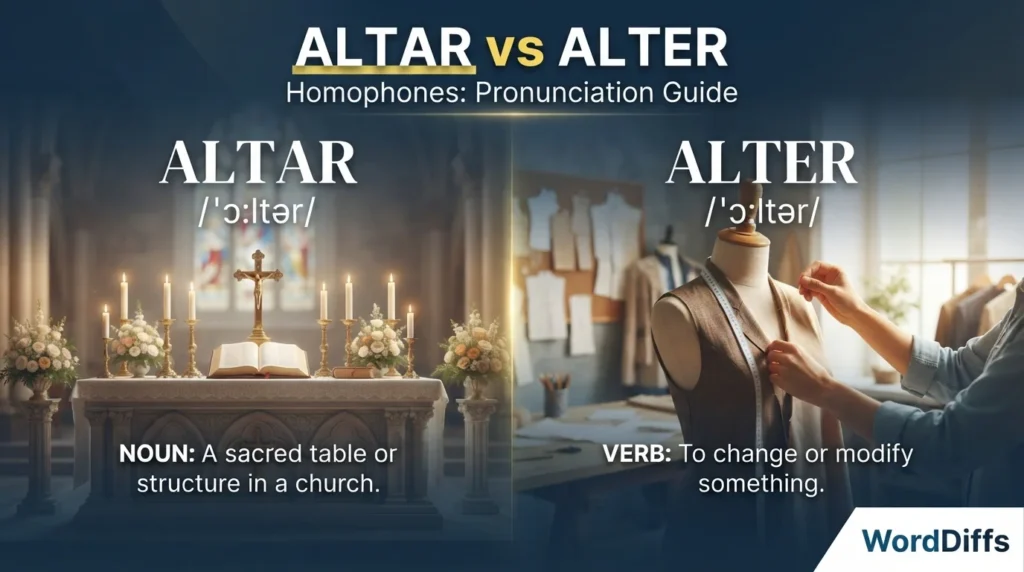
English learners often struggle with homophones because these words sound the same but have different spellings and meanings. Altar and alter are excellent examples. Although they share the same pronunciation in most English accents, they belong to different parts of speech and are used in completely different contexts. Mixing them up can change the meaning of a sentence and create confusion in both academic and everyday writing.
Correct spelling matters because readers rely on word choice to understand your message accurately. Whether you are writing an essay, an email, or a social media post, choosing the right homophone demonstrates strong language skills. Pronunciation also plays an important role since hearing identical sounds can make it difficult to know which spelling is correct without context.
This guide explains the meanings, pronunciation, grammar, origins, usage, collocations, and examples of Altar vs Alter. You will also learn practical memory tricks, common mistakes, quizzes, and expert tips to help you use these homophones confidently.
Quick Difference Table
| Word | Part of Speech | Meaning | Pronunciation (IPA) | Usage | Example |
| Altar | Noun | A sacred table or structure used for religious ceremonies | /ˈɔːl.tər/ (BrE), /ˈɑːl.tɚ/ (AmE) | Religion, weddings, ceremonies | The couple stood before the altar. |
| Alter | Verb | To change or modify something | /ˈɔːl.tər/ (BrE), /ˈɑːl.tɚ/ (AmE) | Everyday, academic, formal writing | Please alter the document before printing. |
Altar
Pronunciation
IPA
- British English: /ˈɔːl.tər/
- American English: /ˈɑːl.tɚ/
Simple pronunciation
ALL-ter
Audio-style spelling
AWL-ter
Does it sound the same as alter?
Yes. In standard British and American English, altar and alter are perfect homophones. They are pronounced the same despite having different spellings and meanings.
British pronunciation
The first syllable contains a longer “aw” sound.
American pronunciation
The first syllable is slightly closer to an “ah” sound, while the final syllable often has the rhotic “r.”
Meaning
An altar is a raised table, platform, or structure used for religious worship, sacrifices, prayers, or ceremonies. It is commonly found in churches, temples, shrines, and other places of worship.
In everyday English, the word also appears in expressions related to marriage and religious commitment.
Part of Speech
Altar is a noun.
It names a person, place, thing, or idea, specifically a sacred object used during religious ceremonies.
Examples:
- The flowers decorated the altar.
- Everyone gathered around the altar.
Origin
The word altar comes from the Latin word altare, meaning “high place” or “place of sacrifice.” It entered English through Old French and Middle English, retaining its religious meaning throughout history.
Today, it continues to refer to sacred structures in many religions around the world.
Common Uses
People commonly use altar in the following contexts:
- Religious ceremonies
- Christian churches
- Weddings
- Temples
- Memorial services
- Prayer services
- Religious literature
- Historical writing
- Cultural discussions
- Architecture
Common Collocations
Some common collocations with altar include:
- church altar
- wedding altar
- stone altar
- family altar
- high altar
- altar cloth
- altar server
- altar rail
- altar candles
- altar flowers
- kneel at the altar
- stand before the altar
- approach the altar
- decorate the altar
- leave something on the altar
Example Sentences
- The bride walked slowly toward the altar.
- Fresh flowers decorated the altar every Sunday.
- The priest stood behind the altar during the ceremony.
- Visitors admired the ancient stone altar.
- The children placed candles on the altar.
- Everyone remained silent near the altar.
- The church restored its historic altar last year.
- They exchanged their vows at the altar.
- The golden altar attracted many tourists.
- Worshippers gathered around the altar for prayer.
- The artist carefully painted the church altar.
- The ceremony began when everyone reached the altar.
- The temple’s altar was beautifully decorated.
- A white cloth covered the altar during the service.
- The minister welcomed the couple at the altar.
Alter
Pronunciation
IPA
- British English: /ˈɔːl.tər/
- American English: /ˈɑːl.tɚ/
Simple pronunciation
ALL-ter
Audio-style spelling
AWL-ter
Does it sound the same as altar?
Yes. Alter is pronounced exactly the same as altar in standard British and American English.
British pronunciation
Features a long “aw” vowel.
American pronunciation
Uses a similar first vowel with a rhotic ending.
Meaning
Alter means to change, modify, adjust, or make something different. The change may be small or significant depending on the context.
It is commonly used when discussing plans, documents, clothing, designs, schedules, rules, or behavior.
Part of Speech
Alter is primarily a verb.
It describes an action involving change.
Examples:
- We need to alter the schedule.
- She decided to alter the design.
Origin
The word alter comes from the Latin verb alterare, meaning “to change.” It entered English through Old French and has been used for centuries to describe modifications or adjustments.
Common Uses
Common situations include:
- altering clothes
- altering plans
- altering schedules
- altering documents
- altering behavior
- altering laws
- altering designs
- altering recipes
- altering opinions
- altering records
Common Collocations
Frequently used collocations include:
- alter plans
- alter clothing
- alter the design
- alter behavior
- alter the schedule
- alter the rules
- alter a document
- alter the recipe
- alter the arrangement
- alter the appearance
- alter the outcome
- alter the course
- alter the structure
- alter the contract
- alter expectations
Example Sentences
- Please alter the report before submitting it.
- The tailor will alter the dress tomorrow.
- We must alter our travel plans.
- The company decided to alter its policy.
- Small changes can alter the final result.
- Exercise can alter your daily routine.
- The editor asked her to alter several paragraphs.
- They refused to alter the original agreement.
- Rain may alter today’s schedule.
- Scientists continue to alter their theories as new evidence appears.
- The chef chose to alter the recipe slightly.
- New technology can alter how people communicate.
- You should not alter official documents without permission.
- The artist wanted to alter the painting’s background.
- One decision can alter your future.
Pronunciation Comparison
Although altar and alter have different meanings and grammatical roles, they are generally considered perfect homophones.
Both are pronounced:
- British English: /ˈɔːl.tər/
- American English: /ˈɑːl.tɚ/
Most native speakers pronounce them identically. Any slight regional differences affect both words equally rather than distinguishing one from the other.
Learners confuse these words because English spelling does not always match pronunciation. Since both words sound alike, only the sentence context reveals which spelling is correct.
Grammar Differences
| Word | Part of Speech | Meaning | Function | Sentence Position | Verb Forms (If Applicable) | Plural Forms (If Applicable) |
| Altar | Noun | Sacred table used in worship | Names a thing | Subject, object, complement | Not applicable | altars |
| Alter | Verb | To change or modify | Expresses an action | Predicate | alter, alters, altered, altering | Not applicable |
Side by Side Examples
| Altar | Alter |
| They stood before the altar. | Please alter the schedule. |
| The church has a beautiful altar. | The tailor will alter my jacket. |
| Flowers surrounded the altar. | We should alter the design. |
| The priest approached the altar. | They refused to alter the contract. |
| Everyone faced the altar. | The teacher asked us to alter our answers. |
| Candles lit the altar. | Exercise can alter your mood. |
| The bride smiled at the altar. | New evidence may alter the conclusion. |
| The ancient altar survived centuries. | Please alter the measurements carefully. |
| Visitors admired the marble altar. | She chose to alter her hairstyle. |
| The choir stood near the altar. | The editor will alter the article. |
| The altar was decorated with roses. | Climate change may alter weather patterns. |
| The minister blessed the altar. | The manager agreed to alter the deadline. |
| They knelt beside the altar. | Do not alter official records. |
| A cross stood above the altar. | Technology continues to alter communication. |
| The family gathered at the altar. | We may alter the route tomorrow. |
| The ceremony ended at the altar. | The software can alter image quality. |
| Children carried flowers to the altar. | Please alter the settings. |
| The old altar was restored carefully. | Good habits can alter your future. |
| The bishop blessed the altar. | They plan to alter the building design. |
| The visitors photographed the altar. | Never alter legal documents without approval. |
Homophones Comparison Table
| Word | Pronunciation | Meaning | Part of Speech | Usage | Example |
| Altar | /ˈɔːl.tər/ (BrE), /ˈɑːl.tɚ/ (AmE) | A sacred table or structure used for religious worship or ceremonies | Noun | Religious services, weddings, churches, temples | The couple exchanged vows at the altar. |
| Alter | /ˈɔːl.tər/ (BrE), /ˈɑːl.tɚ/ (AmE) | To change, modify, or make something different | Verb | Everyday conversations, business, education, legal documents | We need to alter the proposal before the meeting. |
Memory Tricks
Learning the difference between altar and alter becomes much easier when you connect each word with a simple image or spelling clue.
Remembering Altar
- Altar contains “tar.” Imagine a church building with a strong foundation where an altar stands.
- Think of weddings. Couples stand at the altar, not at an “alter.”
- Since altar is a thing, remember that it is always a noun.
Remembering Alter
- Alter begins with “alt,” reminding you of an alternative, which means a change.
- If you alter something, you change it.
- Because changing is an action, alter is a verb.
Visual Memory Trick
Imagine a wedding ceremony.
The bride and groom stand before an altar.
After the ceremony, the tailor alters the wedding dress to fit perfectly.
One is a place.
The other is an action.
Practical Learning Methods
- Read sentences containing both words.
- Create your own examples every day.
- Practice spelling each word five times.
- Say the words aloud while thinking about their meanings.
- Notice the context whenever you encounter these homophones in books or articles.
Common Mistakes
| Incorrect Sentence | Correct Sentence | Explanation |
| They walked to the alter in the church. | They walked to the altar in the church. | A church contains an altar, not an alter. |
| The bride stood at the alter. | The bride stood at the altar. | Weddings take place at an altar. |
| The priest blessed the alter. | The priest blessed the altar. | The sacred structure is an altar. |
| Flowers covered the alter. | Flowers covered the altar. | Use altar for religious objects. |
| The ancient alter was restored. | The ancient altar was restored. | The noun is altar. |
| Please altar the report. | Please alter the report. | Changing something requires the verb alter. |
| We should altar the design. | We should alter the design. | Alter means change. |
| Can you altar this shirt? | Can you alter this shirt? | Tailors alter clothing. |
| They refused to altar the agreement. | They refused to alter the agreement. | Use the verb alter. |
| Exercise can altar your routine. | Exercise can alter your routine. | The action word is alter. |
| The church built a new alter. | The church built a new altar. | Churches have altars. |
| The editor altared the article. | The editor altered the article. | The past tense is altered. |
| She is altering beside the church. | She is standing beside the altar. | Altering is a verb, not a place. |
| We admired the beautiful alter cloth. | We admired the beautiful altar cloth. | The correct collocation is altar cloth. |
| Never altar official records. | Never alter official records. | Use alter for modifying documents. |
Fill in the Blank Quiz
Choose altar or alter to complete each sentence.
- The bride smiled as she approached the ________.
- Please ________ the schedule before tomorrow.
- The church decorated its ________ with flowers.
- We may need to ________ the design.
- Everyone gathered near the ________.
- The tailor will ________ these trousers.
- The priest stood behind the ________.
- Do not ________ the official record.
- Candles were placed on the ________.
- The manager agreed to ________ the deadline.
- The visitors admired the ancient ________.
- Exercise can ________ your lifestyle.
- The minister welcomed the couple at the ________.
- They decided to ________ the recipe slightly.
- A beautiful cross stood above the ________.
- New evidence could ________ the conclusion.
- The flowers looked wonderful on the ________.
- Scientists sometimes ________ their theories.
- The choir gathered around the ________.
- Never ________ legal documents without permission.
Answer Key
- altar
- alter
- altar
- alter
- altar
- alter
- altar
- alter
- altar
- alter
- altar
- alter
- altar
- alter
- altar
- alter
- altar
- alter
- altar
- alter
Choose the Correct Word Quiz
1. The couple exchanged vows at the ________.
A. alter
B. altar
C. altr
D. altor
Correct Answer: B. altar
Explanation: Weddings take place at an altar.
2. Please ________ the document before printing.
A. altar
B. alteredly
C. alter
D. altor
Correct Answer: C. alter
Explanation: Alter means to change.
3. The priest stood beside the ________.
A. alter
B. altar
C. alttar
D. altor
Correct Answer: B. altar
Explanation: An altar is found in places of worship.
4. We should ________ our travel plans.
A. altar
B. alter
C. altor
D. altr
Correct Answer: B. alter
Explanation: Travel plans can be changed or altered.
5. The church restored its historic ________.
A. altar
B. alter
C. altered
D. altor
Correct Answer: A. altar
Explanation: A historic church feature is an altar.
6. Can you ________ this jacket?
A. altar
B. alter
C. altor
D. alttar
Correct Answer: B. alter
Explanation: Tailors alter clothing.
7. The candles were placed on the ________.
A. alter
B. altar
C. altered
D. altor
Correct Answer: B. altar
Explanation: Candles are placed on an altar during ceremonies.
8. New information may ________ our decision.
A. altar
B. alter
C. altor
D. altr
Correct Answer: B. alter
Explanation: Information can change a decision.
9. Everyone looked toward the ________.
A. altar
B. alter
C. altered
D. altor
Correct Answer: A. altar
Explanation: The sentence refers to a sacred structure.
10. Please do not ________ the original file.
A. altar
B. alter
C. altor
D. alttar
Correct Answer: B. alter
Explanation: Files can be modified or altered.
11. The bishop blessed the ________.
A. altar
B. alter
C. altered
D. altr
Correct Answer: A. altar
Explanation: Bishops bless altars during religious ceremonies.
12. We had to ________ the arrangement.
A. altar
B. alter
C. altor
D. altaring
Correct Answer: B. alter
Explanation: The verb alter means “to modify.”
13. The flowers decorated the ________.
A. alter
B. altar
C. altered
D. altor
Correct Answer: B. altar
Explanation: Flowers often decorate an altar.
14. Technology continues to ________ communication.
A. altar
B. alter
C. altor
D. altr
Correct Answer: B. alter
Explanation: Technology changes communication.
15. The guests stood quietly near the ________.
A. alter
B. altar
C. altered
D. altor
Correct Answer: B. altar
Explanation: Guests may stand near an altar during a ceremony.
Common Expressions
Altar
At the Altar
Meaning: Standing at or near the altar, especially during a wedding ceremony.
Example: The bride and groom smiled as they stood at the altar.
Before the Altar
Meaning: In front of the altar during a religious service or ceremony.
Example: The family gathered before the altar to pray.
Lead Someone to the Altar
Meaning: To marry someone, especially in reference to a wedding ceremony.
Example: After years together, he finally led her to the altar.
Kneel at the Altar
Meaning: To kneel in prayer or worship.
Example: Many worshippers knelt at the altar after the service.
Leave Something on the Altar
Meaning: To place an offering or symbolic item on the altar.
Example: Visitors left flowers on the altar as a sign of respect.
Alter
Alter the Course
Meaning: To change the direction or outcome of something.
Example: One important decision can alter the course of your career.
Alter Your Mind
Meaning: To change your opinion or decision.
Example: She may alter her mind after hearing the new information.
Alter the Plan
Meaning: To modify an existing plan.
Example: Rain forced us to alter the plan for the picnic.
Alter the Rules
Meaning: To change existing regulations.
Example: The committee voted to alter the rules.
Alter Beyond Recognition
Meaning: To change something so much that it is difficult to recognize.
Example: The old building was altered beyond recognition after the renovation.
Frequently Asked Questions
What is the difference between altar and alter?
The main difference is that altar is a noun referring to a sacred table or structure used for religious ceremonies, while alter is a verb meaning to change or modify something. Although they sound the same, they have different spellings, meanings, and grammatical functions. Context helps determine which word is correct.
Are altar and alter pronounced the same?
Yes. In both British and American English, altar and alter are generally pronounced the same. They are considered perfect homophones because they share the same pronunciation but have different meanings and spellings.
Why do people confuse altar and alter?
People confuse these words because they sound identical when spoken. Since English spelling does not always match pronunciation, listeners must rely on context to determine whether the speaker is referring to a religious structure or the act of changing something.
Is altar always a noun?
Yes. Altar functions only as a noun. It refers to a physical object used in religious worship or ceremonies. It does not function as a verb, adjective, or adverb in standard English.
Is alter always a verb?
In modern English, alter is primarily used as a verb meaning “to change” or “to modify.” It can appear in different verb forms, such as alters, altered, and altering, but its grammatical role remains verbal.
Can altar refer only to Christian churches?
No. Although altar is commonly associated with Christian churches, many religions have altars. Temples, shrines, and other places of worship may also contain altars used for offerings, prayer, or ceremonial purposes.
When should I use alter?
Use alter whenever you mean to change, adjust, revise, or modify something. It commonly applies to documents, clothing, schedules, plans, policies, recipes, designs, and many other situations involving change.
How can I remember the difference between altar and alter?
Remember that altar is a place used in worship, while alter is an action meaning “to change.” Associating alter with the word alternative can help you remember that both involve change.
Are altar and alter interchangeable?
No. They are never interchangeable because they have completely different meanings. Replacing one with the other creates grammatical and meaning errors that may confuse readers.
Which word is more common in everyday English?
Alter is generally much more common because people frequently discuss changing plans, schedules, documents, and ideas. Altar appears mainly in religious, historical, architectural, or wedding-related contexts.
Can alter be used in academic writing?
Yes. Alter is widely used in formal and academic writing. Researchers, scientists, lawyers, and business professionals often use it to describe changes to methods, policies, data, or conclusions.
Why are homophones difficult for English learners?
Homophones are challenging because identical pronunciation can hide important spelling and meaning differences. Developing strong reading, writing, and vocabulary skills helps learners recognize the correct word from context.
Tips to Remember the Difference
Learning Altar vs Alter becomes much easier with regular practice and simple memory techniques.
Reading Practice
Read books, news articles, and educational materials carefully. Pay attention to whether the sentence discusses religion or change. Identifying the context helps reinforce correct usage.
Writing Practice
Write ten original sentences using altar and ten using alter. Then review each sentence to confirm that the spelling matches the intended meaning.
Pronunciation Practice
Say both words aloud several times. Since they sound the same, focus on understanding the surrounding sentence instead of relying only on pronunciation.
Vocabulary Building
Group related words together.
For altar:
- church
- priest
- worship
- ceremony
- temple
- wedding
For alter:
- change
- modify
- revise
- adjust
- improve
- transform
Building these word groups strengthens long-term memory.
Sentence Creation Exercises
Create pairs of sentences such as:
- The flowers decorated the altar.
- The tailor will alter the jacket.
Comparing the two words side by side makes the difference easier to remember.
Proofreading Habit
Before submitting any piece of writing, check whether the sentence refers to a sacred object or an action of changing something. This quick review helps eliminate one of the most common homophone mistakes.
Summary
Altar and alter are classic English homophones that share the same pronunciation but have entirely different meanings and grammatical roles. Altar is a noun referring to a sacred table or structure used in religious ceremonies, weddings, and places of worship. Alter is a verb meaning to change, modify, or adjust something. Because they sound alike in both British and American English, writers often confuse them, but the surrounding context clearly determines which spelling is correct.
Understanding their pronunciation, meanings, origins, parts of speech, common collocations, and real-world usage will help you avoid spelling mistakes and communicate more accurately. Memory tricks, such as connecting altar with churches and weddings and alter with alternative or change, make these words easier to distinguish. Regular reading, writing, pronunciation practice, and proofreading further reinforce the correct usage. By mastering Altar vs Alter, you will improve your English vocabulary, grammar, and confidence in both spoken and written communication.

Caitlin Boylan is an experienced content writer, editor, educator, travel writer, and remote worker with more than 10 years of experience in English education and international communication. She is the founder and author of The Country Jumper, a travel blog dedicated to supporting solo travelers, especially women exploring life abroad. She is also the co-founder of Macro Magazine, a global online publication that shares diverse perspectives on worldwide topics that impact communities.
1 thought on “Altar vs Alter : Pronunciation, Meaning and Usage Guide”