
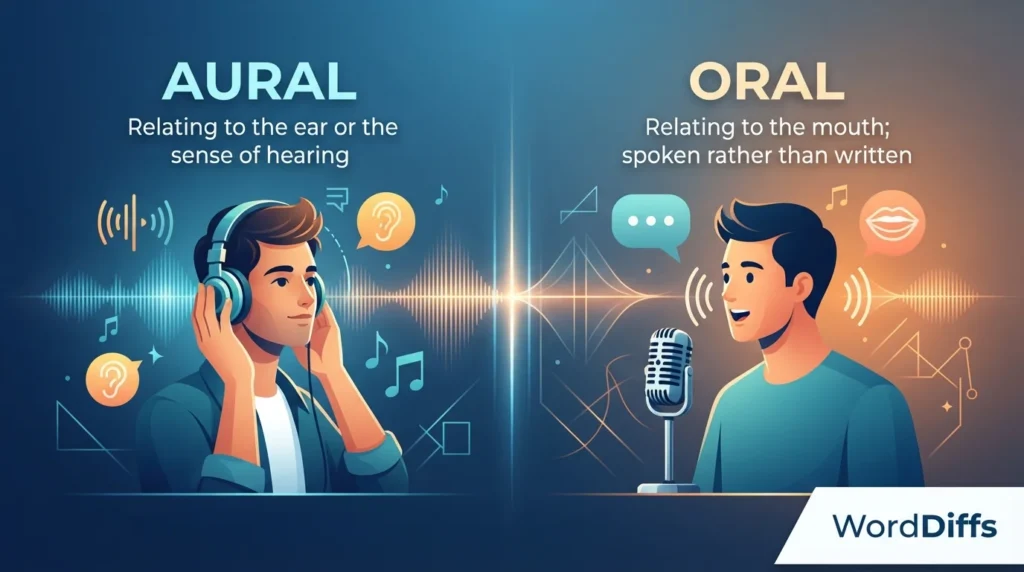
English learners often struggle with Aural vs Oral because these words are pronounced almost identically in many accents but have very different meanings. A single spelling mistake can completely change the intended message. For example, an aural exam focuses on listening skills, while an oral exam requires speaking. Confusing the two can create misunderstandings in education, medicine, law, and everyday communication.
Correct spelling and word choice are essential for clear writing and professional communication. Although pronunciation is similar, understanding each word’s meaning and usage helps you avoid common mistakes. Learning how these homophones function in sentences also strengthens your grammar and vocabulary.
In this guide, you will learn the pronunciation, meanings, grammar, origins, common uses, collocations, and plenty of real-world examples for both aural and oral. You will also discover pronunciation differences, grammar comparisons, memory tricks, quizzes, FAQs, and practical tips to master these commonly confused English homophones.
Quick Difference Table
| Word | Part of Speech | Meaning | Pronunciation (IPA) | Usage | Example |
| Aural | Adjective | Related to hearing or listening | /ˈɔː.rəl/ (UK), /ˈɔr.əl/ (US) | Hearing, sound, listening | The students completed an aural test. |
| Oral | Adjective | Related to the mouth or spoken language | /ˈɔː.rəl/ (UK), /ˈɔr.əl/ (US) | Speech, speaking, mouth | She passed her oral examination. |
Aural
Pronunciation
IPA
- British English: /ˈɔː.rəl/
- American English: /ˈɔr.əl/
Simple pronunciation
AW-ruhl
Audio-style spelling
OR-uhl
Does it sound the same as Oral?
Yes. In most English accents, aural and oral are perfect homophones. They sound the same even though their spellings and meanings differ.
British pronunciation
The first syllable is longer with the vowel /ɔː/.
American pronunciation
The vowel is slightly shorter and rhotic, pronounced /ɔr/.
Meaning
Aural means related to hearing, listening, or the sense of sound.
It is commonly used when discussing music, language learning, hearing tests, communication, and education.
In simple words, if something involves the ears or listening, it is usually described as aural.
Part of Speech
Aural is an adjective.
It modifies nouns by describing something connected with hearing.
Examples:
- aural skills
- aural memory
- aural communication
- aural training
Origin
The word aural comes from the Latin word auris, meaning ear.
It entered English during the nineteenth century to describe matters involving hearing. Today it is widely used in education, music, linguistics, audiology, and communication studies.
Common Uses
Common situations include:
- Listening exercises
- Language learning
- Music education
- Hearing examinations
- Audiology
- Sound recognition
- Speech perception
- Ear training
- Classroom assessments
- Communication research
Common Collocations
- aural skills
- aural test
- aural examination
- aural training
- aural perception
- aural memory
- aural learning
- aural comprehension
- aural feedback
- aural ability
- aural stimulus
- aural experience
- aural communication
- aural instruction
- aural awareness
Example Sentences
- The teacher prepared an aural listening exercise.
- Students practiced their aural skills every week.
- The musician developed excellent aural memory.
- We completed an aural comprehension test yesterday.
- Aural learning helps many language students.
- The child showed impressive aural recognition of bird songs.
- Good aural perception improves communication.
- The course included several aural activities.
- The instructor focused on aural training before the performance.
- Hearing different accents improved her aural understanding.
- His aural abilities developed after years of music lessons.
- The language lab supports aural practice.
- They measured the participants’ aural responses.
- Aural feedback helped improve pronunciation.
- Daily listening exercises strengthened her aural comprehension.
Oral
Pronunciation
IPA
- British English: /ˈɔː.rəl/
- American English: /ˈɔr.əl/
Simple pronunciation
AW-ruhl
Audio-style spelling
OR-uhl
Does it sound the same as Aural?
Yes. Oral and aural are pronounced the same in most varieties of English.
British pronunciation
Uses the long /ɔː/ vowel.
American pronunciation
Uses the rhotic /ɔr/ pronunciation.
Meaning
Oral refers to the mouth, spoken language, or communication through speaking instead of writing.
It is commonly used in education, medicine, dentistry, law, public speaking, and linguistics.
In everyday English, oral usually means spoken rather than written or related to the mouth.
Part of Speech
Oral is primarily an adjective.
It describes nouns connected with speech or the mouth.
Examples:
- oral exam
- oral presentation
- oral history
- oral hygiene
- oral medicine
Origin
The word oral comes from the Latin os, meaning mouth, through the Latin adjective oralis.
It has been part of English since the seventeenth century and remains common in academic, medical, and everyday language.
Common Uses
Typical contexts include:
- Oral examinations
- Oral presentations
- Oral communication
- Oral health
- Oral surgery
- Oral history
- Oral traditions
- Oral instructions
- Oral reports
- Oral agreements
Common Collocations
- oral exam
- oral examination
- oral presentation
- oral communication
- oral history
- oral tradition
- oral hygiene
- oral surgery
- oral health
- oral medication
- oral report
- oral instructions
- oral argument
- oral consent
- oral testimony
Example Sentences
- She passed her oral examination confidently.
- The dentist discussed proper oral hygiene.
- Oral communication is essential in business.
- The lawyer presented an oral argument.
- We gave an oral presentation in class.
- The patient received oral medication.
- The professor preferred oral discussions.
- Oral traditions preserve local history.
- Please provide your answer in oral form.
- The child followed the teacher’s oral instructions.
- Oral storytelling remains popular in many cultures.
- Good oral health requires daily care.
- They reached an oral agreement before signing the contract.
- His oral report impressed the audience.
- The interview included an oral assessment.
Pronunciation Comparison
Although aural and oral have different meanings and spellings, they are considered perfect homophones in most varieties of English.
Are These Words Perfect Homophones?
Yes. In both British and American English, aural and oral are usually pronounced exactly the same.
| Word | British IPA | American IPA | Sounds the Same? |
| Aural | /ˈɔː.rəl/ | /ˈɔr.əl/ | Yes |
| Oral | /ˈɔː.rəl/ | /ˈɔr.əl/ | Yes |
British English
Both words are generally pronounced /ˈɔː.rəl/. Native speakers rely entirely on context to understand which word is intended.
American English
Both are typically pronounced /ˈɔr.əl/. There is no meaningful pronunciation difference in everyday speech.
Regional Variations
Some speakers may pronounce vowels slightly differently depending on their regional accent, but these differences rarely distinguish aural from oral. In nearly every English-speaking region, they remain homophones.
Why Learners Confuse These Words
Learners often confuse these words because:
- They sound identical.
- Both frequently appear in education.
- Both relate to communication.
- Their spellings differ by only one letter.
- Their meanings involve human senses, hearing versus speaking.
Grammar Differences
| Word | Part of Speech | Meaning | Function | Sentence Position | Verb Forms (If Applicable) | Plural Forms (If Applicable) |
| Aural | Adjective | Related to hearing | Describes nouns connected with listening | Before nouns or after linking verbs | Not applicable | Not applicable |
| Oral | Adjective | Related to the mouth or spoken language | Describes nouns connected with speech or the mouth | Before nouns or after linking verbs | Not applicable | Not applicable |
Side-by-Side Examples
| Aural | Oral |
| The student improved her aural skills. | The student passed the oral exam. |
| We practiced aural comprehension today. | We delivered an oral presentation. |
| The course emphasizes aural learning. | Oral communication builds confidence. |
| The musician has excellent aural memory. | The dentist explained oral hygiene. |
| Aural training develops listening accuracy. | The witness gave oral testimony. |
| Their aural perception became stronger. | Oral traditions preserve history. |
| The software includes aural exercises. | Oral instructions were easy to follow. |
| Aural recognition takes practice. | Oral reports are graded carefully. |
| His aural abilities impressed the teacher. | The doctor prescribed oral medicine. |
| Aural feedback improved pronunciation. | She prefers oral discussions. |
| Aural awareness is important for musicians. | Oral consent was accepted. |
| The teacher created an aural quiz. | Oral storytelling entertains children. |
| Aural practice sharpened listening. | The lawyer prepared an oral argument. |
| Aural activities helped beginners. | Oral language develops before writing. |
| Good aural skills improve language learning. | Oral examinations require confident speaking. |
| She completed the aural assessment first. | He answered every oral question correctly. |
| The recording supports aural practice. | Oral explanations clarified the lesson. |
| Children enjoy aural learning games. | Oral feedback motivated the students. |
| Aural instruction improved listening speed. | Oral communication is essential at work. |
| His aural memory helped identify melodies. | Oral practice improved his public speaking. |
Homophones Comparison Table
| Word | Pronunciation | Meaning | Part of Speech | Usage | Example |
| Aural | /ˈɔː.rəl/, /ˈɔr.əl/ | Related to hearing | Adjective | Listening, hearing, music, language learning | The class completed an aural exercise. |
| Oral | /ˈɔː.rəl/, /ˈɔr.əl/ | Related to speech or the mouth | Adjective | Speaking, medicine, presentations | She passed the oral interview. |
Memory Tricks
- Aural begins with Au, which can remind you of Audio.
- Think of aural = ears = listening.
- Oral begins with Or, reminding you of Oral communication, which means speaking.
- Associate oral with mouth and speech.
- Remember: Audio uses your ears, oral uses your mouth.
- Practice by pairing each word with common collocations like aural skills and oral exam.
- Read example sentences aloud to reinforce the difference.
- Create flashcards with pictures of an ear for aural and a mouth for oral.
Common Mistakes
| Incorrect Sentence | Correct Sentence | Explanation |
| We had an oral listening test. | We had an aural listening test. | Listening relates to hearing. |
| Aural hygiene is important. | Oral hygiene is important. | Hygiene refers to the mouth. |
| The oral exercise improved listening. | The aural exercise improved listening. | Listening uses aural. |
| She passed the aural interview. | She passed the oral interview. | Interviews are spoken. |
| Oral perception helps musicians. | Aural perception helps musicians. | Musicians rely on hearing. |
| The dentist checked my aural health. | The dentist checked my oral health. | Dentists treat the mouth. |
| We practiced oral recognition of sounds. | We practiced aural recognition of sounds. | Sound recognition is hearing. |
| Oral memory helped identify melodies. | Aural memory helped identify melodies. | Melodies are remembered by hearing. |
| The witness gave aural testimony. | The witness gave oral testimony. | Testimony is spoken. |
| Aural communication requires speaking. | Oral communication requires speaking. | Speaking is oral. |
| The teacher assigned an oral listening task. | The teacher assigned an aural listening task. | Listening is aural. |
| Oral awareness improved hearing. | Aural awareness improved hearing. | Hearing uses aural. |
| He received aural medicine. | He received oral medicine. | Medicine taken by mouth is oral. |
| The singer improved oral listening skills. | The singer improved aural listening skills. | Listening is aural. |
| We completed an aural presentation. | We completed an oral presentation. | Presentations are spoken. |
Fill in the Blank Quiz
- The students completed an ________ comprehension exercise.
- She passed her ________ examination.
- Good ________ hygiene prevents dental problems.
- The musician has excellent ________ memory.
- The lawyer presented an ________ argument.
- Our teacher assigned an ________ listening activity.
- The doctor prescribed ________ medication.
- The child developed strong ________ perception.
- The class gave an ________ presentation.
- Daily practice improved his ________ skills in music.
- The museum recorded local ________ traditions.
- We completed an ________ hearing assessment.
- The witness provided ________ testimony.
- The language course includes ________ training.
- The dentist explained proper ________ care.
- The recording supports ________ learning.
- The professor prefers ________ discussions.
- The students worked on ________ recognition of sounds.
- She followed the ________ instructions carefully.
- Good ________ ability helps language learners understand native speakers.
Answer Key
- aural
- oral
- oral
- aural
- oral
- aural
- oral
- aural
- oral
- aural
- oral
- aural
- oral
- aural
- oral
- aural
- oral
- aural
- oral
- aural
Choose the Correct Word Quiz
1. Which word relates to hearing?
A. Oral
B. Aural
C. Both
D. Neither
Answer: B
Explanation: Aural refers to hearing or listening.
2. Which word relates to speaking?
A. Aural
B. Hearing
C. Oral
D. Audio
Answer: C
Explanation: Oral refers to spoken communication.
3. Which sentence is correct?
A. I improved my oral listening skills.
B. I improved my aural listening skills.
C. I improved my mouth listening skills.
D. None
Answer: B
Explanation: Listening is aural.
4. An oral exam mainly tests:
A. Reading
B. Listening only
C. Speaking
D. Writing
Answer: C
Explanation: Oral exams require spoken responses.
5. Aural training helps improve:
A. Hearing skills
B. Cooking skills
C. Driving skills
D. Typing skills
Answer: A
Explanation: Aural relates to listening.
6. Oral medicine is taken:
A. Through the ears
B. By mouth
C. Through the skin
D. By injection
Answer: B
Explanation: Oral means by mouth.
7. Which word comes from the Latin word for “ear”?
A. Oral
B. Aural
C. Speech
D. Voice
Answer: B
Explanation: Aural derives from auris.
8. Which word is used with “hygiene”?
A. Aural
B. Oral
C. Both
D. Neither
Answer: B
Explanation: Oral hygiene concerns the mouth.
9. Which collocation is correct?
A. Aural memory
B. Oral memory of sounds
C. Mouth memory
D. Ear hygiene
Answer: A
Explanation: Aural memory relates to remembering sounds.
10. Which word describes spoken history?
A. Aural history
B. Oral history
C. Hearing history
D. Audio history
Answer: B
Explanation: Oral history is passed down through speech.
11. Which word best fits a listening test?
A. Oral
B. Aural
C. Mouth
D. Vocal
Answer: B
Explanation: Listening assessments are aural.
12. Which word refers to communication through speech?
A. Aural
B. Oral
C. Audio
D. Ear
Answer: B
Explanation: Oral communication involves speaking.
13. Are aural and oral pronounced the same?
A. Always differently
B. Usually yes
C. Never
D. Only in American English
Answer: B
Explanation: They are generally perfect homophones.
14. Which field commonly uses aural training?
A. Music
B. Gardening
C. Plumbing
D. Carpentry
Answer: A
Explanation: Musicians develop listening skills through aural training.
15. Which sentence is correct?
A. The dentist checked my aural health.
B. The dentist checked my oral health.
C. The dentist checked my hearing mouth.
D. None
Answer: B
Explanation: Oral health relates to the mouth.
Common Expressions
Aural
Common Expressions
- aural skills
- aural training
- aural perception
- aural memory
- aural awareness
- aural comprehension
Examples
- The conservatory emphasizes aural skills.
- Aural training improved her musical ability.
- His aural memory is remarkable.
Oral
Common Expressions
- oral exam
- oral presentation
- oral history
- oral communication
- oral hygiene
- oral tradition
- oral agreement
Examples
- We have an oral exam tomorrow.
- Good oral hygiene protects your teeth.
- Oral traditions preserve cultural heritage.
Frequently Asked Questions
What is the difference between aural and oral?
Aural relates to hearing and listening, while oral relates to the mouth or spoken communication. Although they sound the same in most English accents, they are used in completely different contexts.
Are aural and oral pronounced the same?
Yes. In standard British and American English, they are generally pronounced identically, making them perfect homophones.
Why do people confuse these homophones?
People confuse them because they sound alike, have similar spellings, and are commonly used in education, especially when discussing language learning and examinations.
When should I use aural?
Use aural whenever something relates to hearing, listening, sound recognition, music training, or auditory learning.
When should I use oral?
Use oral when discussing speech, the mouth, presentations, interviews, examinations, medicine taken by mouth, or spoken traditions.
Is an oral exam the same as an aural exam?
No. An oral exam tests speaking ability, while an aural exam tests listening and comprehension skills.
Does aural only refer to music?
No. Although common in music education, aural is also used in language learning, audiology, communication, and hearing science.
Can oral describe written communication?
No. Oral specifically refers to spoken communication, not written language.
How can I remember the difference?
Remember Audio begins with Au, just like Aural. Think of Oral as connected to the mouth and speaking.
Are these words interchangeable?
No. Despite identical pronunciation, they cannot replace each other because their meanings are entirely different.
Tips to Remember the Difference
- Read articles containing both words and identify their contexts.
- Practice writing sentences using each word correctly.
- Listen to recordings and notice how context reveals the intended meaning.
- Build vocabulary by learning common collocations.
- Create your own example sentences every day.
- Use flashcards with an ear for aural and a mouth for oral.
- Review common mistakes regularly.
- Practice speaking and listening activities separately to reinforce the distinction.
Summary
Understanding Aural vs Oral is important because these words are perfect homophones in most English accents but have very different meanings. Aural relates to hearing, listening, sound, and auditory learning, while oral refers to the mouth, spoken language, speech, and communication. Although their pronunciation is virtually identical in British and American English, context makes their meanings clear.
Both words function as adjectives and frequently appear in education, medicine, music, communication, and professional settings. Learning their origins, common collocations, and typical sentence patterns helps you use them accurately. A simple memory trick is to connect aural with audio and oral with the mouth and speaking. Regular reading, listening, writing, and speaking practice will strengthen your understanding and reduce confusion. By mastering these commonly confused homophones, you can communicate more precisely, avoid spelling mistakes, and improve both your written and spoken English with greater confidence.

Caitlin Boylan is an experienced content writer, editor, educator, travel writer, and remote worker with more than 10 years of experience in English education and international communication. She is the founder and author of The Country Jumper, a travel blog dedicated to supporting solo travelers, especially women exploring life abroad. She is also the co-founder of Macro Magazine, a global online publication that shares diverse perspectives on worldwide topics that impact communities.