
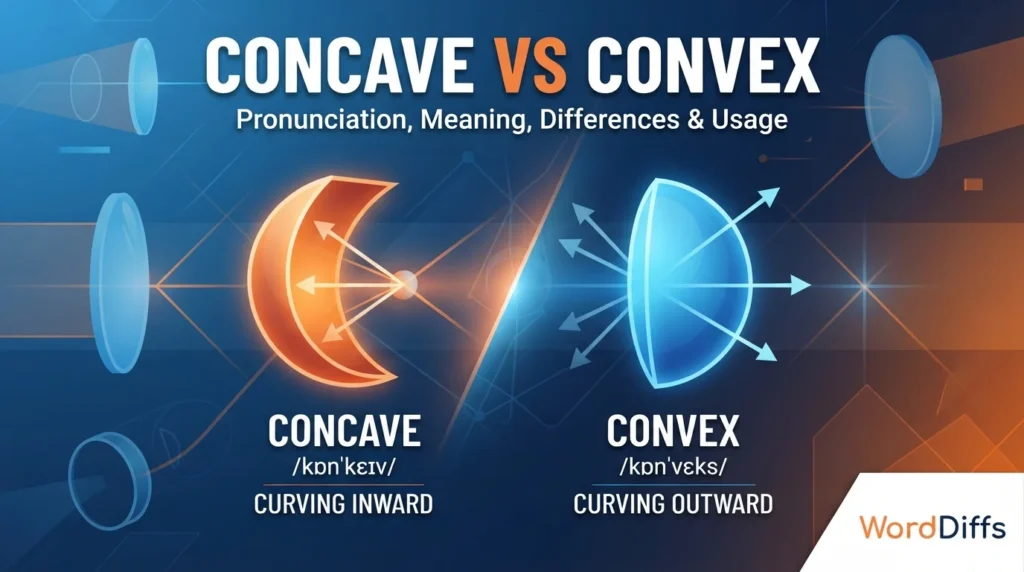
When learning English, some words are difficult because they describe similar ideas but have opposite meanings. Concave vs Convex is one such comparison. These words are commonly used in mathematics, science, optics, engineering, architecture, and everyday descriptions of shapes. Many learners confuse them because both words describe curved surfaces, but the direction of the curve is different.
Understanding the difference between concave and convex helps students, teachers, writers, and professionals use these terms accurately. A concave shape curves inward, while a convex shape curves outward. Although these words are not homophones, synonyms, or commonly confused because of pronunciation, they are often mixed up because both relate to curved objects.
In this guide, you will learn the pronunciation, meanings, grammar, examples, common uses, related words, mistakes, and memory techniques that make it easy to remember the difference between concave and convex.
The Miner vs Minor pronunciation and spelling guide helps distinguish these easily confused words.
Concave
Pronunciation
American IPA: /kɑːnˈkeɪv/
British IPA: /kɒnˈkeɪv/
Easy Pronunciation Guide: kon-KAYV
The word concave has two syllables:
- con
- cave
The stress falls on the second syllable: KAYV.
Beginner Pronunciation Tips
- The first part sounds like “con” in “connect.”
- The second part sounds like “cave”, the place where people explore underground.
- Avoid pronouncing it as “CON-cave.” The stronger stress is on the second syllable.
Correct pronunciation:
✅ con-KAYV
❌ CON-cav
Meaning
Concave describes a surface or shape that curves inward, like the inside of a bowl, spoon, or cave.
A concave object has a hollow or depressed center. The middle part goes inward rather than sticking outward.
Common meanings of concave include:
- Curved inward
Example:
A concave mirror has a surface that bends inward. - Having a hollow shape
Example:
The inside of a bowl is concave. - A shape that receives or collects light
Example:
Concave mirrors are used in telescopes because they can focus light.
Real-Life Contexts of Concave
The word concave appears in many fields:
- Optics: concave mirrors and lenses
- Mathematics: concave curves and functions
- Biology: concave surfaces in body structures
- Engineering: curved designs and structures
- Architecture: inward-curving designs
Examples:
- A shaving mirror can have a concave surface.
- Some contact lenses have concave shapes.
- A cave-like structure is naturally concave.
Examples of Color and Colour in everyday English writing make this common spelling variation easier to recognize.
Part of Speech
Part of Speech: Adjective
Sentence Function: Concave describes the shape, surface, or structure of a noun.
Examples:
- a concave mirror
- a concave surface
- a concave curve
The word usually appears before a noun as a modifier.
Grammar and Usage
Concave is an adjective, so it modifies nouns related to shapes, objects, and surfaces.
Common grammar patterns:
- concave + noun
- noun + be + concave
- more/less + concave (for comparison)
Examples:
- The mirror has a concave surface.
- This curve is concave.
- The design is more concave than the previous model.
Common Collocations with Concave
| Collocation | Meaning | Example |
| Concave mirror | A mirror curved inward | The scientist used a concave mirror to focus light. |
| Concave lens | A lens thinner in the middle | A concave lens helps correct certain vision problems. |
| Concave surface | An inward-curved surface | The machine contains a concave surface. |
| Concave curve | A curve that bends inward | The graph shows a concave curve. |
| Concave shape | An inward form | The container has a concave shape. |
Grammar Function
| Grammar Function | Explanation | Example |
| Subject | Concave is usually not used as a subject because it is an adjective. | Concave describes an inward curve. |
| Object | It can appear after verbs describing conditions. | Scientists studied the concave surface. |
| Modifier | It describes a noun by showing its inward curve. | The concave mirror reflected light. |
A clear explanation of Analogy vs Allegory usage in literature and communication helps readers choose the right term.
Example Sentences
1. The dentist examined the concave shape of the tooth structure.
Meaning:
The dentist looked at a surface that curved inward.
Grammar Explanation:
“Concave” is an adjective modifying the noun “shape.”
2. The telescope uses a concave mirror to collect and focus light.
Meaning:
The mirror curves inward and helps control light.
Grammar Explanation:
“Concave” functions as a modifier before the noun “mirror.”
3. The artist created a bowl with a deep concave design.
Meaning:
The bowl has an inward-curved appearance.
Grammar Explanation:
“Concave” describes the type of design.
4. The scientist measured the concave surface carefully.
Meaning:
The scientist examined an inward-curved area.
Grammar Explanation:
“Concave” modifies “surface.”
5. The graph shows a concave curve.
Meaning:
The curve bends inward.
Grammar Explanation:
“Concave” acts as an adjective before the noun “curve.”
6. The engineer designed a concave structure for better performance.
Meaning:
The structure has an inward curve.
Grammar Explanation:
The adjective describes the noun “structure.”
Related Words
| Related Word | Meaning | Example Sentence |
| Concavity | The state of being curved inward | The engineer studied the concavity of the surface. |
| Concavely | In an inward-curved way | The material was shaped concavely. |
| Curve | A rounded line or surface | The road has a sharp curve. |
| Hollow | Having an empty or inward space | The object has a hollow center. |
Common Uses of Concave
Concave is often used when describing:
- Mirrors
- Lenses
- Graphs
- Curves
- Surfaces
- Containers
- Shapes
Examples:
- Concave mirror
- Concave lens
- Concave function
- Concave surface
Common Mistakes with Concave
Many learners remember that both concave and convex describe curves but forget the direction.
Common mistakes:
❌ A ball has a concave surface.
✅ A ball has a convex surface.
Explanation:
A ball curves outward, so it is convex.
❌ A spoon’s inside surface is convex.
✅ A spoon’s inside surface is concave.
Explanation:
The inside of a spoon curves inward.
Memory Tip for Concave
Remember:
Concave contains “cave.”
A cave goes inward into the ground.
Concave = Cave-like = Curves inward
Visual memory:
Imagine pushing your hand into a soft ball. The dent you create is concave.
Convex
Pronunciation
American IPA: /kənˈveks/
British IPA: /kənˈveks/
Easy Pronunciation Guide: kun-VEKS
The word convex has two syllables:
- con
- vex
The stress falls on the second syllable: VEKS.
Beginner Pronunciation Tips
- The first syllable is weak and sounds like “kuhn.”
- The second syllable sounds like “veks.”
- Do not pronounce it with equal stress on both syllables.
Correct pronunciation:
✅ kun-VEKS
❌ CON-vex
Meaning
Convex describes a surface or shape that curves outward.
A convex object has a raised or rounded center. The middle part extends outward instead of going inward.
Common meanings of convex include:
- Curved outward
Example:
A magnifying glass has a convex lens.
- Rounded or bulging
Example:
The outside of a ball is convex.
- A shape that spreads or reflects outward
Example:
Convex mirrors provide a wider field of view.
Real-Life Contexts of Convex
Convex is used in many areas:
- Optics: convex lenses and mirrors
- Vehicles: side-view mirrors
- Mathematics: convex shapes and functions
- Design: rounded objects
- Biology: outward-curved structures
Examples:
- A basketball has a convex surface.
- A car side mirror is usually convex.
- A magnifying glass uses a convex lens.
Part of Speech
Part of Speech: Adjective
Sentence Function: Convex describes the outward shape of an object.
Examples:
- a convex mirror
- a convex surface
- a convex curve
Grammar and Usage
Convex follows the same adjective patterns as concave.
Common structures:
- convex + noun
- noun + be + convex
- more/less + convex
Examples:
- The lens is convex.
- The designer created a convex shape.
- This surface is more convex than the other one.
Common Collocations with Convex
| Collocation | Meaning | Example |
| Convex mirror | A mirror curved outward | Cars use convex mirrors for wider visibility. |
| Convex lens | A lens thicker in the middle | A magnifying glass contains a convex lens. |
| Convex surface | An outward-curved surface | The object has a convex surface. |
| Convex shape | A rounded outward form | The sculpture has a convex shape. |
| Convex curve | A curve bending outward | The design includes a convex curve. |
Grammar Function
| Grammar Function | Explanation | Example |
| Subject | Convex functions as an adjective, not usually a subject. | Convex describes outward curves. |
| Object | It can describe objects being studied. | The engineer tested the convex surface. |
| Modifier | It modifies nouns related to shapes. | The convex lens improved the image. |
Example Sentences
1. The car uses a convex mirror to increase visibility.
Meaning:
The mirror curves outward and allows drivers to see more area.
Grammar Explanation:
“Convex” modifies the noun “mirror.”
2. A magnifying glass has a convex lens.
Meaning:
The lens curves outward and enlarges objects.
Grammar Explanation:
“Convex” is an adjective describing the lens.
3. The ball has a naturally convex surface.
Meaning:
The surface curves outward.
Grammar Explanation:
The adjective “convex” modifies “surface.”
4. The architect designed a building with convex walls.
Meaning:
The walls curve outward.
Grammar Explanation:
“Convex” describes the noun “walls.”
5. The scientist studied the convex shape of the object.
Meaning:
The scientist examined an outward-curving form.
Grammar Explanation:
“Convex” acts as a descriptive adjective.
6. The camera uses a convex lens to capture wider images.
Meaning:
The lens helps control light by using an outward curve.
Grammar Explanation:
“Convex” modifies “lens.”
Related Words
| Related Word | Meaning | Example Sentence |
| Convexity | The quality of being curved outward | The convexity of the surface was measured. |
| Convexly | In an outward-curved way | The material bends convexly. |
| Rounded | Having a curved shape | The table has rounded edges. |
| Bulging | Pushing outward | The balloon became bulging after inflation. |
Common Uses of Convex
Convex is commonly used with:
- Mirrors
- Lenses
- Shapes
- Curves
- Surfaces
- Objects
Examples:
- Convex mirror
- Convex lens
- Convex shape
- Convex curve
Common Mistakes with Convex
❌ A dent in a car door is convex.
✅ A dent in a car door is concave.
Explanation:
A dent goes inward.
❌ A bubble has a concave surface.
✅ A bubble has a convex surface.
Explanation:
A bubble curves outward.
Memory Tip for Convex
Remember:
Convex = Vex = Victory shape that sticks outward.
Another visual trick:
A convex object looks like it is pushing outward toward you.
Convex = Comes outward
Key Differences Between Concave vs Convex
Concave and convex are both adjectives used to describe curved shapes and surfaces, but they describe opposite directions of curvature.
A concave shape curves inward, creating a hollow or depressed area. A convex shape curves outward, creating a rounded or raised area.
| Feature | Concave | Convex |
| Pronunciation | /kɑːnˈkeɪv/ (American), /kɒnˈkeɪv/ (British) | /kənˈveks/ (American and British) |
| Meaning | Curves inward | Curves outward |
| Part of Speech | Adjective | Adjective |
| Grammar | Used before nouns to describe inward curves | Used before nouns to describe outward curves |
| Typical Usage | Mirrors, lenses, surfaces, curves, graphs | Mirrors, lenses, surfaces, curves, objects |
| Visual Appearance | Like the inside of a bowl or cave | Like the outside of a ball |
| Memory Tip | Concave contains “cave,” which goes inward | Convex means a shape that comes outward |
| Example | A spoon’s inside is concave | A ball’s surface is convex |
Concave vs Convex: Simple Explanation
The easiest way to understand the difference is to imagine your hand pressing into a soft object.
- If you create a dent, the shape is concave because it goes inward.
- If something pushes outward like a balloon, the shape is convex because it comes outward.
Another example:
- The inside of a spoon is concave.
- The back of a spoon is convex.
Both surfaces belong to the same object, but they curve in different directions.
Comparing Concave vs Convex in Real Life
Mirrors
Concave and convex mirrors work differently because of their shapes.
A concave mirror curves inward and can focus light. It is used in:
- Telescopes
- Headlights
- Makeup mirrors
A convex mirror curves outward and spreads light. It is used in:
- Vehicle side mirrors
- Security mirrors
- Road safety mirrors
Example:
The dentist uses a concave mirror to see enlarged images of teeth.
The car uses a convex mirror to show a wider area behind the vehicle.
Lenses
Both concave and convex lenses affect light differently.
A concave lens curves inward and usually spreads light rays.
A convex lens curves outward and usually brings light rays together.
Examples:
- Eyeglasses for some vision corrections use concave lenses.
- Magnifying glasses use convex lenses.
Shapes and Objects
Many everyday objects have concave or convex surfaces.
Concave examples:
- Inside of a bowl
- A cave opening
- A dent
- Inside of a spoon
Convex examples:
- Ball
- Balloon
- Outside of a spoon
- Rounded button
Sentence Comparisons
1. The inside of the bowl is concave, but the outside is convex.
Why each word is correct:
- The inside curves inward, so it is concave.
- The outside curves outward, so it is convex.
Grammar Role:
Both words are adjectives describing surfaces.
2. The scientist tested a concave mirror and a convex mirror.
Why each word is correct:
- The concave mirror focuses light inward.
- The convex mirror spreads light outward.
Grammar Role:
Both adjectives modify the noun “mirror.”
3. The spoon has a concave side and a convex side.
Why each word is correct:
- The inside of the spoon curves inward.
- The back of the spoon curves outward.
Grammar Role:
Both words describe different surfaces of the same object.
4. The photographer used a convex lens to capture a larger view.
Why each word is correct:
A convex lens is designed with an outward curve that affects light.
5. The engineer repaired the concave surface of the machine.
Why each word is correct:
The surface had an inward curve, so concave is the correct term.
6. The ball has a convex shape because it extends outward.
Why each word is correct:
The rounded outside of the ball creates an outward curve.
7. The mirror was concave, allowing the image to appear larger.
Why each word is correct:
Concave mirrors can magnify objects when positioned correctly.
8. The security mirror was convex, giving people a wider view.
Why each word is correct:
Convex mirrors show a larger viewing area.
Common Mistakes Between Concave and Convex
Mistake 1
Incorrect Sentence:
The outside of a football is concave.
Correct Sentence:
The outside of a football is convex.
Explanation:
A football’s surface curves outward, so it is convex.
Mistake 2
Incorrect Sentence:
The inside of a spoon is convex.
Correct Sentence:
The inside of a spoon is concave.
Explanation:
The spoon’s inner surface creates a hollow curve.
Mistake 3
Incorrect Sentence:
A dent in a car is convex.
Correct Sentence:
A dent in a car is concave.
Explanation:
A dent pushes the surface inward.
Mistake 4
Incorrect Sentence:
A bubble has a concave shape.
Correct Sentence:
A bubble has a convex shape.
Explanation:
A bubble expands outward.
Mistake 5
Incorrect Sentence:
A car side mirror is concave.
Correct Sentence:
A car side mirror is convex.
Explanation:
Vehicle side mirrors curve outward to increase visibility.
Mistake 6
Incorrect Sentence:
A magnifying glass uses a concave lens.
Correct Sentence:
A magnifying glass uses a convex lens.
Explanation:
Magnifying glasses use convex lenses to enlarge images.
Mistake 7
Incorrect Sentence:
A cave entrance is convex.
Correct Sentence:
A cave entrance is concave.
Explanation:
A cave goes inward, which matches concave.
Mistake 8
Incorrect Sentence:
The surface of a ball is concave.
Correct Sentence:
The surface of a ball is convex.
Explanation:
A ball has a rounded outward surface.
Easy Memory Tricks for Concave and Convex
Memory Trick 1: Use the Word “Cave”
The word concave contains cave.
A cave goes inward into the earth.
Therefore:
Concave = Curves inward
Memory Trick 2: Think About “Coming Out”
Convex can remind you of something that extends outward.
Therefore:
Convex = Comes outward
Memory Trick 3: Use Everyday Objects
Remember these examples:
Concave:
- Inside of spoon
- Bowl interior
- Dent
Convex:
- Ball
- Balloon
- Outside of spoon
Memory Trick 4: Use Your Hand
Make a fist.
Push your thumb into a soft surface:
The dent = concave.
Make a rounded fist:
The outside curve = convex.
Practice Quiz
1. Choose the correct word:
The inside of a bowl is usually ______.
A) Convex
B) Concave
Correct Answer: Concave
Explanation:
The inside surface curves inward.
2. Fill in the blank:
A car side mirror is generally ______.
Correct Answer: Convex
Explanation:
Convex mirrors provide a wider field of view.
3. Choose the correct sentence:
A) The balloon has a concave shape.
B) The balloon has a convex shape.
Correct Answer: B
Explanation:
A balloon curves outward.
4. Fill in the blank:
A dent in metal creates a ______ surface.
Correct Answer: Concave
Explanation:
A dent pushes the surface inward.
5. Choose the correct word:
A magnifying glass uses a ______ lens.
A) Concave
B) Convex
Correct Answer: Convex
Explanation:
Convex lenses enlarge images.
6. Correct the sentence:
“The outside of a basketball is concave.”
Correct Answer:
“The outside of a basketball is convex.”
Explanation:
The surface curves outward.
7. Choose the correct word:
A telescope may use a ______ mirror to collect light.
Correct Answer: Concave
Explanation:
Concave mirrors focus light.
8. Fill in the blank:
The inside of a cave is ______.
Correct Answer: Concave
Explanation:
A cave extends inward.
9. Choose the correct sentence:
A) The spoon’s inner surface is concave.
B) The spoon’s inner surface is convex.
Correct Answer: A
Explanation:
The spoon’s inner surface curves inward.
10. Choose the correct word:
A rounded ball has a ______ surface.
Correct Answer: Convex
Explanation:
A ball curves outward.
Frequently Asked Questions
What is the difference between concave and convex?
Concave means a surface curves inward, while convex means a surface curves outward.
Are concave and convex opposites?
Yes. They describe opposite directions of curvature.
How do you pronounce concave?
Concave is pronounced as con-KAYV.
American IPA: /kɑːnˈkeɪv/
How do you pronounce convex?
Convex is pronounced as kun-VEKS.
IPA: /kənˈveks/
Is a spoon concave or convex?
The inside of a spoon is concave, while the back of a spoon is convex.
Is a ball concave or convex?
A ball is convex because its surface curves outward.
Is a mirror concave or convex?
Mirrors can be both. Concave mirrors curve inward, while convex mirrors curve outward.
What type of lens is used in a magnifying glass?
A magnifying glass uses a convex lens.
What does concave mean in simple words?
Concave means curved inward like the inside of a bowl.
What does convex mean in simple words?
Convex means curved outward like the surface of a ball.
Are concave and convex nouns?
No. They are usually adjectives.
Can concave and convex describe graphs?
Yes. In mathematics, they describe the shape and direction of curves.
Why do people confuse concave and convex?
People confuse them because both describe curved shapes, but they refer to opposite directions.
Which word means inward curve?
Concave means an inward curve.
Which word means outward curve?
Convex means an outward curve.
Final Summary
The difference between concave vs convex becomes simple when you focus on the direction of the curve.
Concave means curved inward. It is associated with hollow shapes, dents, caves, and surfaces that go inside. It is pronounced con-KAYV.
Convex means curved outward. It describes rounded shapes, bulging surfaces, and objects that extend outward. It is pronounced kun-VEKS.
Both words are adjectives commonly used before nouns such as mirror, lens, surface, shape, and curve. The easiest way to remember them is:
- Concave = cave = goes inward
- Convex = comes outward
For English learners, the best approach is to connect each word with familiar objects. Think of a bowl or dent for concave, and a ball or balloon for convex. With these visual connections, choosing the correct word becomes much easier.

Josie Palmer is an experienced SEO Content Consultant, content strategist, and founder of JOT SEO, a consultancy focused on helping businesses improve their search visibility through effective SEO and content strategies. With more than 8 years of experience in SEO, content development, and digital marketing, she specializes in creating data-driven content strategies that help businesses grow online.