
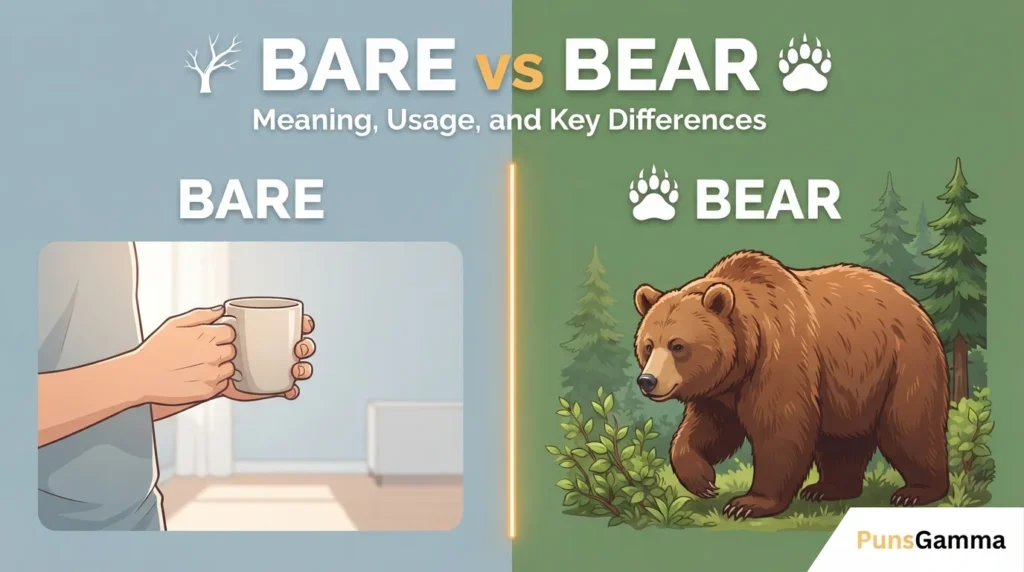
Many English learners confuse bare and bear because they sound exactly alike but have completely different meanings. These two words are homophones, which means they share the same pronunciation but have different spellings and meanings. Using the wrong one can make your sentence confusing or even change its meaning entirely.
In this guide, you’ll learn what bare and bear mean, how to pronounce them, when to use each word, common grammar patterns, frequent learner mistakes, and plenty of real-life examples. By the end, you’ll be able to choose the correct word with confidence in both writing and everyday conversations.
Context plays an important role when comparing Observation vs Observance in English usage across different situations.
Quick Difference Table
| Word | Part of Speech | Meaning | Example | Common Usage |
| Bare | Adjective, verb | Without covering, clothing, or decoration; to uncover | She walked on the bare floor. | Describing something uncovered or exposing something |
| Bear | Noun, verb | A large animal; to carry, tolerate, support, or produce | I can’t bear the heat. | Talking about animals, carrying, enduring, or producing |
Meaning of Bare
Meaning
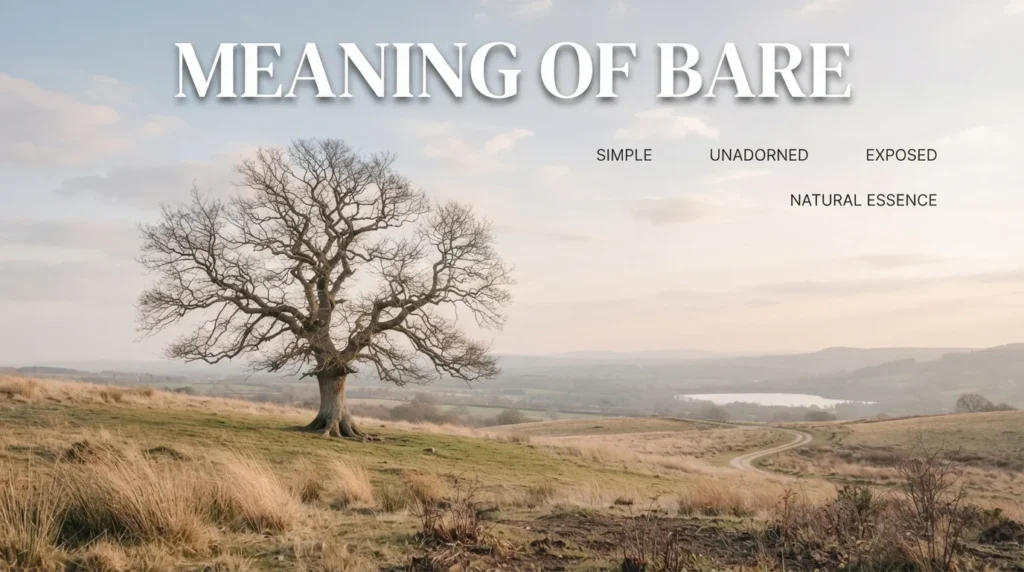
The word bare usually means uncovered, exposed, or without something that normally covers it. It often describes people, objects, or places that are not protected, clothed, decorated, or hidden.
As a verb, bare means to uncover, reveal, or expose something.
Although bare has more than one meaning, the idea of removing a covering or leaving something exposed connects all of its uses.
Pronunciation
| Feature | Details |
| IPA | /ber/ |
| American Pronunciation | ber |
| British Pronunciation | ber |
| Syllables | 1 |
| Word Stress | The only syllable is stressed. |
Pronunciation Tips
- Bare rhymes with care, share, fair, and chair.
- The vowel sound is the same as in air.
- It is pronounced exactly the same as bear.
- Remember that spelling, not pronunciation, tells you which word to use.
- Practice by saying: bare, care, fair, share.
Function
Part of Speech
- Adjective
- Verb
Grammar Role
As an adjective, bare describes a noun.
Examples
- bare feet
- bare walls
- bare hands
- bare branches
As a verb, it means to reveal or uncover something.
Examples
- bare your soul
- bare the truth
- bare your teeth
Sentence Function
As an adjective, bare appears before a noun or after a linking verb.
Examples:
- The room looked bare.
- She had bare arms.
As a verb, it is followed by an object.
Examples:
- Please bare your shoulder.
- The dog bared its teeth.
Common Grammatical Patterns
- bare + noun
- be + bare
- bare + object
- completely bare
- almost bare
- nearly bare
Example Sentences
- She walked across the room with bare feet.
- The trees stood bare after the leaves had fallen.
- Please bare your arm before the nurse gives you the shot.
- The apartment looked bare without any furniture.
- The mountain had bare rocks at the top.
- He bared his teeth when he laughed.
- We found a bare patch of ground for our picnic.
- The walls were bare because no pictures had been hung yet.
- The report bared the truth about the company’s mistakes.
- During the winter, the garden looked completely bare.
When to Use
Use bare when you want to describe something that is uncovered, exposed, empty, or without its usual covering.
Common situations include:
- Describing uncovered body parts
- bare feet
- bare hands
- bare shoulders
- Talking about empty or undecorated places
- bare walls
- bare room
- bare shelves
- Referring to exposed land or trees
- bare branches
- bare ground
- bare mountain
- Showing that something has been revealed
- bare the facts
- bare your feelings
- bare the truth
Common Mistakes
Mistake 1: Using “bear” instead of “bare” for uncovered things
❌ She has bear feet.
✅ She has bare feet.
Why?
Feet without shoes are bare, not bear.
Mistake 2: Using “bare” when talking about tolerating something
❌ I can’t bare this noise.
✅ I can’t bear this noise.
Why?
When you mean tolerate or endure, use bear.
Mistake 3: Confusing the spelling because the words sound identical
Since bare and bear are pronounced the same, many learners choose the wrong spelling while writing.
A helpful memory trick is:
- Bare contains are, which can remind you of something already uncovered.
- Think of bare skin, bare floor, or bare trees, all of which are exposed.
Mistake 4: Forgetting that “bare” can also be a verb
Many learners think bare is only an adjective.
Correct examples:
- Please bare your shoulder.
- She bared her feelings.
- The investigation bared the truth.
Understanding both the adjective and verb forms will help you use bare accurately in everyday English
Meaning of Bear
Meaning
The word bear has two main uses in English.
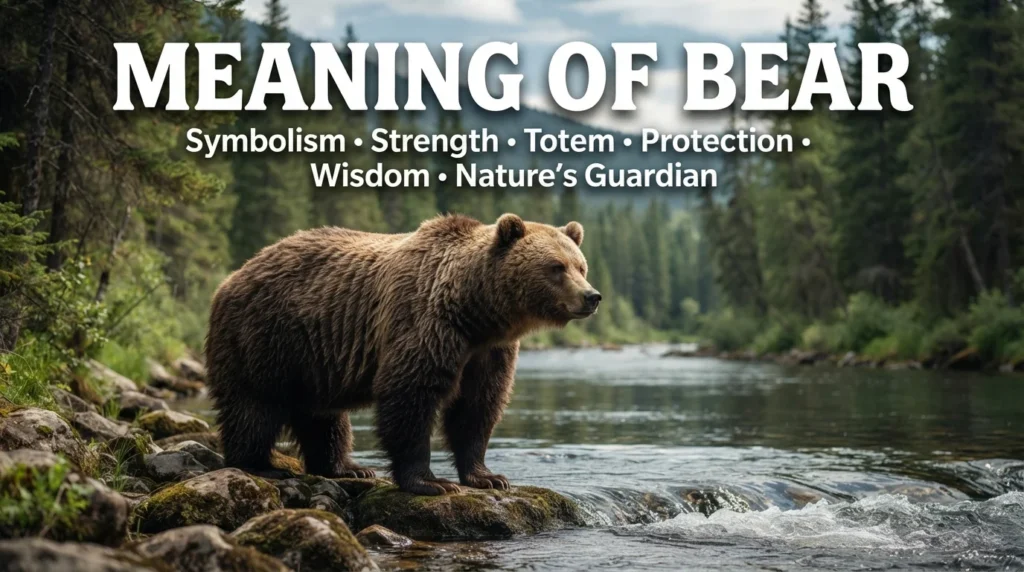
As a noun, a bear is a large, powerful mammal found in many parts of the world. Different species include black bears, brown bears, polar bears, and pandas (often called giant pandas).
As a verb, bear most commonly means to carry, support, endure, tolerate, accept, or produce. The correct meaning depends on the context, but it usually involves holding something, dealing with something, or bringing something into existence.
Although these meanings seem different, they all relate to the idea of supporting, carrying, or handling something.
Pronunciation
| Feature | Details |
| IPA | /ber/ |
| American Pronunciation | ber |
| British Pronunciation | ber |
| Syllables | 1 |
| Word Stress | The only syllable is stressed. |
Pronunciation Tips
- Bear rhymes with care, chair, fair, and share.
- It is pronounced exactly the same as bare.
- Listen for the long air sound.
- The spelling determines the meaning because the pronunciation is identical.
- Practice saying: bear, care, fair, share.
Function
Part of Speech
- Noun
- Verb
Grammar Role
As a noun, bear names an animal.
Examples:
- A bear lives in the forest.
- We saw a bear at the national park.
As a verb, bear expresses an action such as carrying, enduring, supporting, or producing.
Examples:
- bear the weight
- bear responsibility
- bear children
- bear fruit
- bear a name
Sentence Function
As a noun, bear can be the subject or object of a sentence.
Examples:
- The bear climbed a tree.
- We photographed a bear.
As a verb, bear is followed by an object.
Examples:
- She couldn’t bear the pain.
- The bridge can bear heavy traffic.
Common Grammatical Patterns
- bear + object
- bear responsibility
- bear the cost
- bear the burden
- bear the pain
- bear fruit
- bear witness
- bear in mind
- cannot bear + noun
- cannot bear + infinitive
Learning Metal vs Mettle pronunciation and spelling can help prevent confusion when writing or speaking English.
Example Sentences
- We spotted a bear near the river during our hike.
- I can’t bear listening to loud music all day.
- This old bridge can bear the weight of heavy trucks.
- She had to bear the responsibility for the project.
- The apple tree will bear fruit next summer.
- He couldn’t bear to watch the sad movie again.
- A mother bear carefully protected her cubs.
- Please bear in mind that the office closes early today.
- The company agreed to bear the repair costs.
- Good friendships can bear the test of time.
When to Use
Use bear when you mean:
Talking about the animal
- a black bear
- a brown bear
- a polar bear
- a bear cub
Expressing tolerance or endurance
- bear the pain
- bear the noise
- bear disappointment
- bear criticism
Showing support or carrying something
- bear the weight
- bear responsibility
- bear the burden
- bear the cost
Describing production or results
- bear fruit
- bear children
- bear a name
- bear witness
Common expressions
- bear in mind
- grin and bear it
- bear with me
- bear responsibility
Common Mistakes
Mistake 1: Using “bare” instead of “bear” to mean tolerate
❌ I can’t bare this cold weather.
✅ I can’t bear this cold weather.
Why?
When you mean endure, tolerate, or put up with, the correct word is bear.
Mistake 2: Using “bare” in common expressions
❌ Please bare with me.
✅ Please bear with me.
Why?
The expression bear with me means “be patient with me.”
Mistake 3: Forgetting that “bear” has many verb meanings
Some learners think bear only refers to the animal.
However, it is commonly used to mean:
- carry
- support
- endure
- accept responsibility
- produce
Examples:
- The wall can bear the load.
- She couldn’t bear the sadness.
- The tree bears fruit every year.
Mistake 4: Confusing the spelling because both words sound alike
Since bear and bare are homophones, learners often rely on pronunciation instead of meaning.
A simple memory trick is:
- Think of a bear carrying a heavy backpack.
- The image of carrying something helps you remember that bear often means carry, support, or endure.
Side-by-Side Comparison
| Situation | Correct Word | Explanation | Example |
| Talking about feet without shoes | Bare | Means uncovered or without a covering | She walked across the grass with bare feet. |
| Referring to the wild animal | Bear | Names a large mammal | We saw a bear in the forest. |
| Describing an empty room | Bare | Means lacking furniture or decoration | The apartment looked bare after they moved out. |
| Saying you cannot tolerate something | Bear | Means endure or put up with | I can’t bear the loud noise. |
| Revealing the truth | Bare | Means uncover or expose | The investigation bared the facts. |
| Supporting heavy weight | Bear | Means carry or support | The bridge can bear heavy traffic. |
| Talking about trees without leaves | Bare | Means exposed or uncovered | The bare branches swayed in the wind. |
| Paying expenses | Bear | Means accept responsibility for | The company will bear the costs. |
| Describing uncovered skin | Bare | Means not covered by clothing | He had bare arms in the summer. |
| Producing fruit | Bear | Means produce | Apple trees bear fruit every fall. |
Practice Quiz
Fill in the Blanks
Choose bare or bear to complete each sentence.
- Please remove your shoes and walk with your ______ feet.
- I can’t ______ the smell of smoke.
- The old tree was completely ______ during winter.
- We watched a brown ______ cross the road.
- The bridge can ______ thousands of cars every day.
- The walls looked ______ after all the paintings were removed.
- Please ______ with me while I find the document.
- The investigation helped ______ the truth.
- This orange tree will ______ fruit next season.
- The child stood on the cold, ______ floor.
Choose the Correct Word
Select the correct answer.
1. She couldn’t _____ the pain after the accident.
A. bare
B. bear
C. beer
D. boar
2. We saw a _____ eating berries near the campsite.
A. bare
B. bear
C. bore
D. beard
3. The apartment looked _____ after the furniture was removed.
A. bear
B. bare
C. bore
D. bears
4. Please _____ your arm so the doctor can examine it.
A. bear
B. bare
C. bore
D. bearing
5. Good apple trees usually _____ fruit every year.
A. bare
B. bear
C. bore
D. bearing
6. I can’t _____ to see animals treated badly.
A. bare
B. bear
C. bore
D. beard
7. The hikers walked across the stream with _____ feet.
A. bear
B. bare
C. bore
D. bearing
8. The company agreed to _____ the repair costs.
A. bare
B. bear
C. bore
D. beard
9. During autumn, the trees become _____.
A. bear
B. bare
C. bore
D. bearing
10. Please _____ in mind that the store closes at 8 p.m.
A. bare
B. bear
C. bore
D. beard
Answer Key
Fill in the Blanks
- bare – Feet without shoes are bare because they are uncovered.
- bear – Bear means to tolerate or endure.
- bare – Trees without leaves are described as bare.
- bear – This refers to the animal.
- bear – Bear means to support or carry weight.
- bare – The room lacked decoration or furniture.
- bear – Bear with me is a fixed expression meaning “be patient.”
- bare – Bare means to reveal or uncover.
- bear – Fruit trees bear fruit.
- bare – The floor was uncovered.
Multiple-Choice Answers
- B. bear – Bear means to endure or tolerate pain.
- B. bear – The sentence refers to the animal.
- B. bare – Bare means empty or without decoration.
- B. bare – Bare means to uncover an arm.
- B. bear – Trees bear fruit.
- B. bear – Bear means tolerate or endure.
- B. bare – Feet without shoes are bare.
- B. bear – Bear means accept or take responsibility for costs.
- B. bare – Trees become bare when they lose their leaves.
- B. bear – The phrase is bear in mind, meaning “remember.”
Final Thoughts
Understanding the difference between bare and bear becomes much easier once you focus on their meanings instead of their pronunciation. Although the two words sound exactly the same, bare usually refers to something that is uncovered, exposed, or revealed, while bear can refer to a large animal or mean to carry, support, endure, or produce. Paying attention to the context will help you choose the correct spelling every time.
An easy memory trick is to think of bare feet, bare walls, and bare branches whenever you see bare. For bear, imagine a strong bear carrying a heavy load to remind yourself that the verb often means to carry or endure. The more you read, write, and practice these words in everyday sentences, the more natural the correct choice will become.
Frequently Asked Questions
What is the main difference between bare and bear?
Bare means uncovered, exposed, or to reveal something. Bear refers to a large animal or means to carry, support, endure, or produce.
Are bare and bear pronounced the same?
Yes. They are homophones, so they have the same pronunciation but different spellings and meanings.
Is bare a noun?
No. Bare is commonly used as an adjective and a verb.
Is bear both a noun and a verb?
Yes. As a noun, it names the animal. As a verb, it means to carry, tolerate, support, or produce.
Why do people confuse bare and bear?
People confuse them because they sound identical when spoken. The correct choice depends entirely on the meaning of the sentence.
Which word is correct in “bare feet”?
Bare is correct because it means feet without shoes or socks.
Which word is correct in “I can’t bear it”?
Bear is correct because it means “I can’t tolerate it.”
What does “bear with me” mean?
Bear with me means “Please be patient with me.”
What does “bare your soul” mean?
It means to reveal your deepest thoughts or emotions honestly.
Can a tree bear fruit?
Yes. The verb bear means “to produce,” so fruit trees bear fruit.
Is “bear the cost” correct?
Yes. Bear the cost means to accept or pay the expense.
Is “bare the cost” ever correct?
No. The correct expression is bear the cost because it means to accept responsibility for paying.
How can I remember the difference between bare and bear?
Think of bare skin or bare feet for something uncovered. Think of a strong bear carrying a heavy backpack to remember that bear often means carry, support, or endure.

Josie Palmer is an experienced SEO Content Consultant, content strategist, and founder of JOT SEO, a consultancy focused on helping businesses improve their search visibility through effective SEO and content strategies. With more than 8 years of experience in SEO, content development, and digital marketing, she specializes in creating data-driven content strategies that help businesses grow online.
1 thought on “Bare vs. Bear: Meaning, Pronunciation & Key Differences”